


In brief
- Content, SEO and paid teams often plan separately, so the same customer questions get answered three ways, or not at all.
- Google Ads search terms and Search Console queries show what customers actually ask, in their own words.
- Build one shared question bank, map it to intent, and give each team a clear role.
Most brands have three teams talking to the same customer. The content team plans around campaigns and brand moments. The SEO team plans around keywords. The paid search team plans around search terms and budgets. Each one sees part of the picture, and the customer sees the gaps.
The fix isn’t a new tool. It’s a shared view of what customers are actually asking, and an agreement on who answers which question.
Why should you care?
Your search data already tells you what customers want to know. The Google Ads search terms report shows the real queries that triggered your ads, with clicks and conversions next to each one. The Search Console Performance report shows the queries your site appears for in organic results, with impressions, clicks and average position.
Put the two together and you have your customers’ questions in their own words, with evidence of which ones lead to business. Yet many content calendars never look at either. That means content that ranks for nothing, paid campaigns sending traffic to pages that don’t answer the question, and budget spent twice on the same topic.
Map every question to an intent
Group your questions by what the customer is trying to do, then decide which team leads.
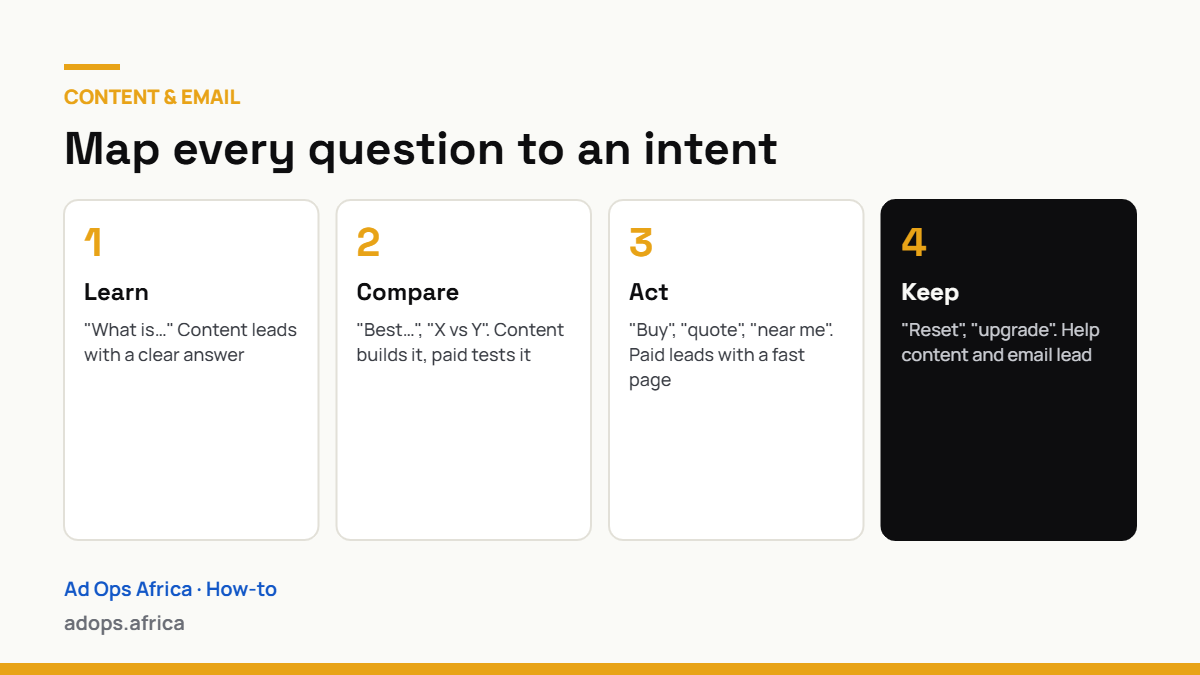
- Learn. “What is…”, “how does…”. Content leads with a clear, search-friendly answer. Paid is usually optional here.
- Compare. “Best…”, “X vs Y”, “prices”. Content builds the comparison page; paid tests it as a landing page for high-intent terms.
- Act. “Buy”, “near me”, “quote”, “contact”. Paid leads, with a fast landing page. Content supports with FAQs and proof.
- Keep. “How do I reset…”, “cancel”, “upgrade”. Help content and email lead. Don’t pay to answer questions your existing customers ask.
What does it mean in African markets?
Customers search in local terms that global keyword tools can miss: “lay-by” and rand prices in South Africa, English mixed with Swahili or Pidgin in Kenya and Nigeria, and practical questions about data bundles, delivery and paying on delivery. Filter Search Console by country to see these differences instead of averaging them away.
Many journeys also end off your website, in a WhatsApp chat or a call. Ask your sales and customer service teams for the questions they hear every week. They belong in the same question bank.
Hypothetical example: a Kenyan insurer sees paid clicks on “car insurance for Uber drivers Nairobi” convert well, but has no page answering it. Content writes the guide, paid points the ad group at it, and both teams track the same question.
What should you do next?
- Build one question bank. A shared sheet with the question, intent, country, monthly impressions and clicks, conversions, and the owner.
- Feed it monthly. Add the top converting paid search terms, high-impression Search Console queries with low click-through, site search terms and customer service FAQs.
- Brief from the question. Every content brief starts with the exact question and the intent, not just a keyword.
- Connect the pages. Use strong content as paid landing pages where it fits, and link paid landing pages back to deeper content.
- Review overlap carefully. When a page ranks well, test paid coverage on that query before cutting it. Don’t switch it off on assumption.
How do you measure success?
- The share of your priority questions that have a page answering them.
- Organic clicks on the queries mapped to each page, by country.
- Conversion rate on content-led paid landing pages versus standard ones.
- Blended cost per acquisition for a topic across paid and organic, not each channel alone. Our guide to search visibility measurement goes deeper.
Share with your team
Our content, SEO and paid plans should start from the same list of customer questions. Each month we’ll add what people actually searched for, agree who answers what, and measure the topic, not just the channel.
Read next: The search terms report routine · SEO, GEO and AEO explained
Sources
- Google Ads Help: About the search terms report
- Search Console Help: Performance report (Search results)
- Google Search Central: Creating helpful, reliable, people-first content
Researched and drafted with AI assistance, then reviewed, fact-checked and edited by Pilira Mwambala. See our Editorial & AI Policy.