



In brief
- When search engines answer on the results page, clicks can fall even as your visibility grows.
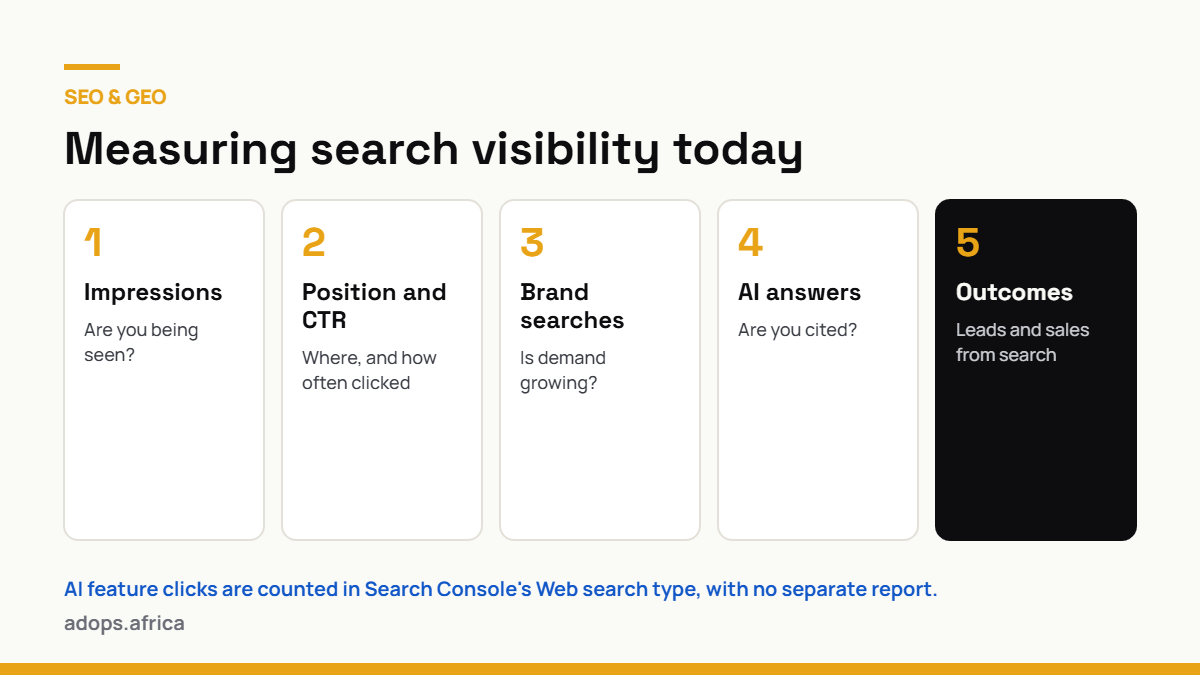
- Measure five things: impressions, position and click-through rate, brand searches, AI citations and business outcomes.
- Search Console counts AI feature traffic in its normal Web report; there is no separate AI report.
For years, search success meant one chart going up: organic clicks. Now Google’s AI Overviews, featured snippets and other answers often satisfy the searcher on the results page itself. Visibility and clicks no longer move together. Here’s how to measure what search is really doing for you.
1. Impressions: are you being seen?
In Google Search Console’s Performance report, impressions show how often your pages appeared in results. Rising impressions with flat or falling clicks usually means you’re visible but the answer is being given on the results page. That’s not necessarily bad, but you need to know it’s happening.
Google counts clicks and impressions from its AI features, such as AI Overviews, in the same Performance report, under the Web search type. There’s no separate AI report, so you can’t isolate that traffic there.
2. Position and click-through rate
Look at average position and CTR for your most important queries, not the site average. Group queries by topic or intent. A query where you rank first but CTR has halved probably now has an AI answer or other feature above you.
3. Brand searches
Searches for your brand name are a good signal that your wider marketing, including being cited in AI answers, is building demand. Filter Search Console queries containing your brand, and watch the trend monthly. Google Trends helps for comparisons with competitors.
4. AI answers and citations
There’s no complete report for AI visibility yet, so measure it directly. List the 20 questions your customers ask most. Once a month, ask them in Google, ChatGPT and Perplexity, and record whether you’re mentioned or linked. In GA4, check referral traffic from chatgpt.com, perplexity.ai and similar sources.
5. Outcomes
In GA4, look at organic search sessions that lead to your key events, such as leads, sign-ups or sales, by landing page. A page with fewer clicks but more conversions is doing better, not worse. Our tracking plan guide helps keep the conversion data clean.
Setting it up in Search Console
- Open Performance → Search results and set the date range to the last three months, compared with the same period last year.
- Add a query filter that contains your brand name, and save the results. Then switch the filter to ‘doesn’t contain’ for non-brand.
- Switch on the impressions, clicks, CTR and position columns together, so you see visibility and clicks side by side.
- Use the Pages tab to find landing pages whose impressions rose while clicks fell. Those are the pages most affected by answers on the results page.
- Export both views monthly, or connect Search Console to Looker Studio.
A hypothetical example
A Nairobi software company sees organic clicks fall 15% year on year and assumes SEO has failed. Search Console shows non-brand impressions up 20% and brand searches up 10%, while CTR on its ‘how to’ pages has dropped sharply. Those pages now appear inside AI Overviews. Organic sign-ups in GA4 are flat. The conclusion: visibility is growing and conversions are holding; the answers are simply being read on Google.
Build a simple monthly dashboard
- Impressions and clicks from Search Console, for brand and non-brand queries separately.
- CTR and average position for your top 20 queries.
- Your AI citation check for your 20 key questions.
- Organic conversions and revenue from GA4, by landing page.
Looker Studio connects to both Search Console and GA4 for free, so the dashboard can update itself. Keep it to one page that you can read in five minutes.
Why it matters in Africa
Many African businesses rely on organic search because paid media is priced in dollars and budgets are tight. If clicks fall and nobody measures impressions or citations, it can look like SEO stopped working when it’s actually the results page that changed. Measuring visibility properly protects the investment. And because AI answers about African markets often lack good local sources, being cited is a real, measurable win.
Common mistakes
- Reporting clicks alone. It hides visibility gains and blames SEO for changes on Google’s side.
- Mixing brand and non-brand. Brand searches can mask a drop in new-customer discovery, or the other way round.
- Judging month to month. Search moves slowly; compare with the same month last year where you can.
How to measure success
Success now means stable or growing impressions for your important topics, more brand searches, more citations in AI answers, and more conversions from organic search, even if total clicks are flat.
Share with your team
Search success isn’t just clicks any more. Track impressions, CTR by topic, brand searches, AI citations and conversions, monthly, on one page.
Read next: SEO, GEO and AEO explained · How to show up in AI Overviews
Sources
- Google Search Central: AI features and your website
- Google Search Console Help: Performance report (Search results)
Researched and drafted with AI assistance, then reviewed, tested and edited by Pilira Mwambala. See our Editorial & AI Policy.



