



In brief
- WhatsApp Business has two routes: the free app for small teams, and the paid Business Platform.
- Since July 2025 Meta charges per delivered message; more charges started on 1 October 2026.
- Under POPIA, marketing messages need opt-in consent, and every message must offer a way out.
In most African markets, WhatsApp is where customers already are. Brands use it for orders, support, reminders and offers, often with better response rates than email. But it isn’t free at scale, and in South Africa the rules on marketing messages are strict. Here’s how to choose the right set-up and use it properly.
App or platform?
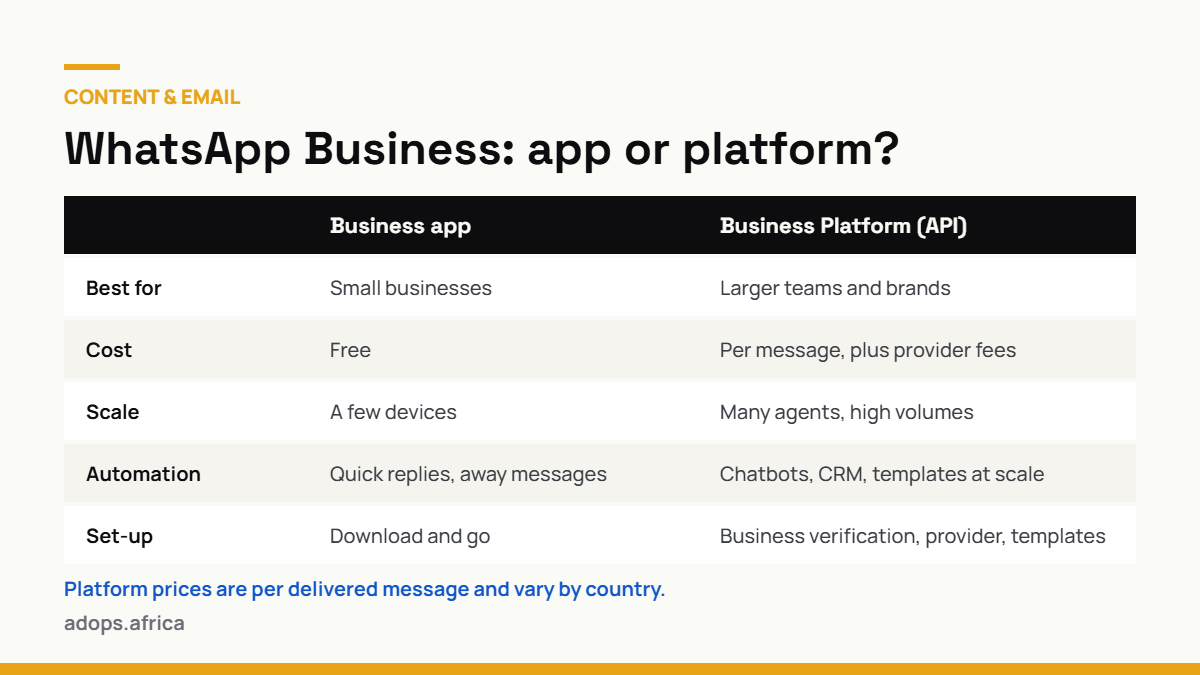
- The WhatsApp Business app is free and runs on a phone. It suits small businesses: a profile, catalogue, labels, quick replies and away messages. It’s limited to a few devices and isn’t built for automation or high volumes.
- The WhatsApp Business Platform (the API) is for larger teams. It connects to your CRM and support tools, supports chatbots and many agents, and can send approved template messages at scale. Most businesses access it through a Meta business solution provider, which adds its own fees.
How the platform is priced
Since 1 July 2025, Meta charges per delivered message, not per conversation. The price depends on the message type and the recipient’s country. South Africa has its own rate; most other African countries share a ‘Rest of Africa’ rate.
- Marketing templates: offers, announcements, re-engagement. The most expensive category.
- Utility templates: order updates, delivery notices, reminders.
- Authentication templates: one-time passwords.
- Service messages: free-form replies within 24 hours of a customer messaging you.
Two changes took effect on 1 October 2026. Utility messages sent inside the 24-hour window are now charged, and service messages beyond 1,000 free per phone number each month are charged. Meta also raised South Africa’s utility and authentication rates that day. Rates are billed in a currency you choose at set-up, and the rand isn’t one of the options, so your costs move with the exchange rate. Check the current rate card before you budget.
The cheapest route in: click-to-WhatsApp ads
When someone taps a Click to WhatsApp ad on Facebook or Instagram and you reply within 24 hours, Meta opens a free window of up to seven days. All template and service messages in that window are free. For many brands, that makes ads the most cost-effective way to start conversations.
The rules in South Africa
Under section 69 of POPIA, direct marketing by electronic communication, which includes WhatsApp, needs the person’s consent unless they are an existing customer who bought something similar from you and was given a chance to opt out. Since the April 2025 amendments to the POPIA Regulations, an opt-out approach doesn’t count as consent. WhatsApp’s own policy adds that you may only message people who have opted in to hear from you.
- Collect opt-in clearly, and say what you’ll send and how often.
- Keep a record of when and how each person opted in.
- Give an easy way out in every marketing message, for example ‘Reply STOP’.
- Never buy or upload lists of numbers.
Setting up the platform
- Verify your business in Meta Business Manager. You’ll need company documents.
- Choose your access route. Use Meta’s Cloud API directly if you have developers, or a business solution provider if you want a ready-made inbox and support.
- Register a phone number and a display name that matches your brand. Meta reviews the name.
- Write and submit your templates. Every message you start must use a template Meta has approved, in the right category.
- Add a payment method before you go live, so messages aren’t blocked once the free allowance runs out.
Use cases that work
- Order and delivery updates. Customers want them and read them.
- Appointment reminders. Fewer no-shows for clinics, salons and services.
- Support with a human backup. A bot for common questions, with a clear route to a person.
- Abandoned-cart reminders, sent only to customers who opted in.
- Lead qualification from ads. Click-to-WhatsApp ads into a short set of questions before a sales call.
When not to use it
WhatsApp feels personal, which is its strength and its risk. It isn’t the place for long newsletters, cold outreach or messages at 10pm. And once customers can message you, they expect replies: if you can’t staff the inbox during the hours you promise, set clear away messages, or don’t open the channel yet. A slow WhatsApp reply does more damage than no WhatsApp at all.
Measure it properly
Track cost per conversation and cost per sale, not just open rates. Tag your click-to-WhatsApp campaigns so you can see which ads lead to orders, and watch opt-out rates: if they climb, you’re sending too much. For one month, send the same reminder by WhatsApp, SMS and email to similar groups, and compare cost per result. It’s the quickest way to know where WhatsApp earns its place.
Read next: Meta’s new AI ad tools: what African advertisers can use now · Retail media in South Africa: who sells it and how to buy it
Sources
- Meta for Developers: Pricing on the WhatsApp Business Platform
- Information Regulator (South Africa): Protection of Personal Information Act
Researched and drafted with AI assistance, then reviewed, fact-checked and edited by Pilira Mwambala. See our Editorial & AI Policy.



