



In brief
- Affiliate networks and ad platforms each count the sales they can see, so the same order is often claimed twice.
- Add up their reports and you’ll get more sales than you made.
- Agree a de-duplication rule and a brand bidding policy before Black Friday, not after.
It’s Black Friday week, and your reports are about to disagree. The affiliate network says it drove a sale, Google Ads says it drove the same sale, and finance asks why marketing claims more orders than the business took. This explainer covers why it happens, what it costs, and how to fix it.
Why two channels claim the same sale
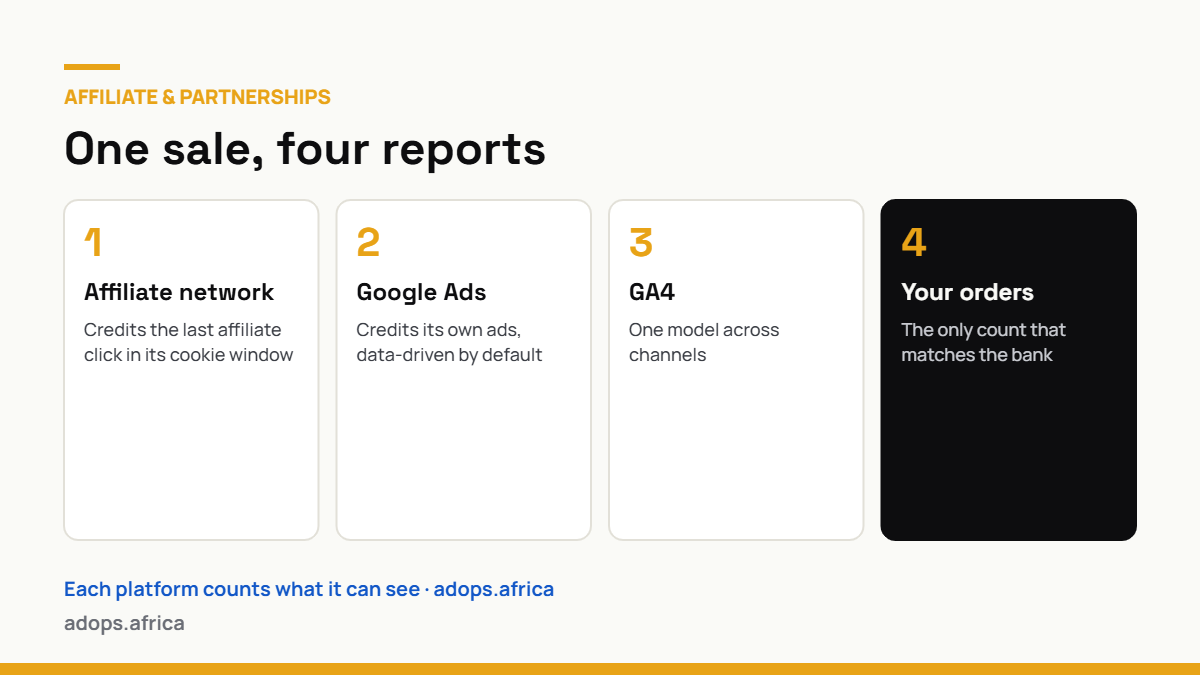
Each platform counts the conversions it can see, using its own rules:
- Affiliate networks usually credit the last affiliate click within their cookie window, and pay commission on that basis.
- Google Ads credits its own ad interactions. Google says data-driven attribution is now the default for most conversion actions.
- GA4 applies one model across channels. It offers data-driven, paid and organic last click, and Google paid channels last click, and gives direct visits no credit unless the whole path is direct.
None of these is wrong. They are answering different questions. The trouble starts when you add their numbers together, or pay commission on a sale another channel has already been credited for.
What it looks like in practice
Hypothetical example: a South African online retailer takes 1,000 orders in November. Google Ads reports 620 conversions and the affiliate network reports 540. Together that’s 1,160, so at least 160 orders were claimed by both. A common path: a shopper clicks a paid search ad for the brand name, then visits a voucher site to look for a discount code, then buys. Both channels count the sale, and the voucher site is paid commission.
Two patterns make overlap worse in busy periods like Black Friday:
- Voucher and cashback sites often catch shoppers who had already decided to buy.
- Affiliates bidding on your brand name in search can push up your own brand CPCs and take credit for searches you’d have won anyway.
Why it matters to practitioners
Overlap costs money twice: you pay commission on sales another channel drove, and you over-invest in whichever channel’s dashboard looks best. In African markets, where budgets are tight and finance teams are watching cost per sale closely, a channel report that doesn’t reconcile with the bank loses trust quickly. Our guide to affiliate marketing in African markets covers setting up tracking and commission in the first place.
How to fix it
1. Decide your source of truth
Make your order system or CRM the count everyone reconciles to. Platform reports explain how each channel contributed; they don’t decide how many sales you made.
2. De-duplicate commission
Networks support de-duplication so that only one partner is paid for each sale. Awin’s documentation, for example, describes passing a channel value on each click, storing the most recent source in a cookie, and firing the affiliate tag only when an affiliate was the last referrer. Awin recommends de-duplicating against other networks, generic paid search, email and direct partnerships, but not against brand paid search, organic search or direct traffic, because partners may feel their contribution is discounted. Whatever rule you choose, publish it in your programme terms.
3. Set a brand bidding policy
State in your programme terms whether affiliates may bid on your brand name, use it in ad copy, or link directly to your site from search ads. Check search results for your brand terms regularly, especially during sales.
4. Test what each channel adds
Attribution tells you who was there; it doesn’t tell you what would have happened without them. To learn whether a voucher partner adds sales, try pausing it in one period or region and compare. Our explainer on attribution vs incrementality explains how.
How to measure success
- The sum of channel-claimed sales moves closer to your actual order count.
- Commission as a share of affiliate revenue stays steady, rather than rising in peak weeks.
- Brand search costs don’t spike when affiliate activity does.
Ad Ops Africa has no commercial relationship with Awin or any network mentioned in this article. If that changes, we’ll say so here.
Share with your team
Before Black Friday we’ll reconcile platform-claimed sales against our order system, check our affiliate de-duplication rule and brand bidding terms, and plan a holdout test for our biggest voucher partner.
Read next: Affiliate marketing in African markets · Attribution vs incrementality · Can you trust your campaign numbers?
Sources
- Google Ads Help: About attribution models
- Google Analytics Help: Advertising and attribution (attribution models)
- Awin Help: De-duplication
Researched and drafted with AI assistance, then reviewed, fact-checked and edited by Pilira Mwambala. See our Editorial & AI Policy.