



In brief
- AI now sets bids, picks audiences, writes ads and chooses placements across Google, Meta and TikTok.
- It optimises well towards the goal and data it’s given, and it can’t judge whether those are right.
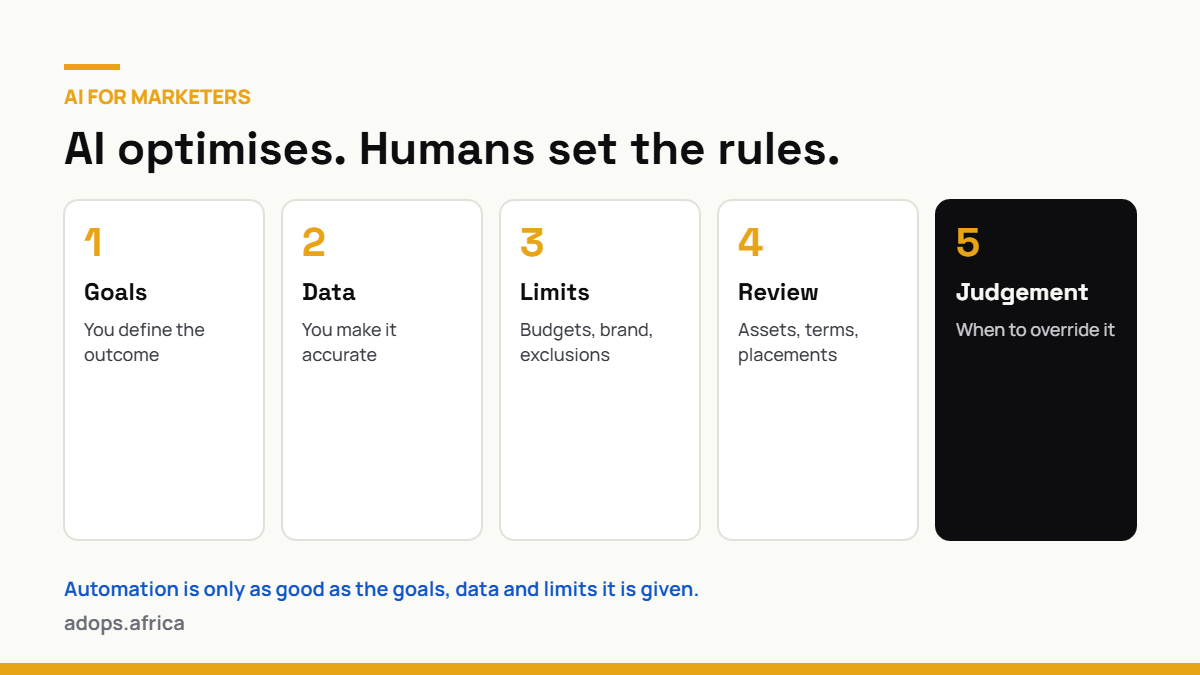
- Humans still own five things: goals, data, limits, review and the judgement to override.
Performance Max, AI Max for Search, Advantage+ and Smart+ have moved much of campaign management into the platforms’ AI. That’s often good: automated systems process far more signals than any person. But automation optimises towards whatever it’s told to, with whatever data it gets. Here’s where it helps, and where human QA still matters.
Where automation helps
- Bidding: setting a bid for every auction based on many signals at once. Our Smart Bidding guide covers what it needs.
- Audience finding: broad targeting often beats hand-built interest lists, because the system learns who responds.
- Creative combinations: testing headlines, images and formats at a scale no team could manage manually.
- Budget allocation: moving spend between placements and channels within a campaign.
Where humans still matter
- Goals. The system will chase cheap leads if you tell it leads are the goal, even if those leads never buy. Choosing the right outcome, and its value, is a human job.
- Data. Automation trusts every conversion it’s given. Double counting, wrong values or broken tags send it in the wrong direction. Test tracking before you trust the results.
- Limits. Budgets, brand safety, negative keywords, placement exclusions and audience exclusions are your guard rails. The system won’t add them for you.
- Review. Check the search terms, placements and AI-generated assets the system uses. Generated headlines and images can be off-brand, inaccurate or non-compliant, especially for regulated products.
- Judgement. Knowing when to override: a stock shortage, a price change, a PR crisis, a public holiday. The algorithm doesn’t read the news.
A hypothetical example
A Lagos fintech switches its app campaign to full automation and sees installs double at half the cost. Three weeks later, the product team notices that very few new users complete identity verification. The system had found people who install apps cheaply, not people who open accounts. The fix: change the optimisation event to ‘account verified’, give it a value, and accept a higher cost per install for far more real customers. The automation worked perfectly. The goal was wrong.
A weekly QA routine for automated campaigns
- Search terms and AI Max matches: anything irrelevant or risky?
- Placements and channels: where did Performance Max or Advantage+ actually spend?
- Assets: are generated headlines, images and videos accurate and on-brand?
- Conversions: do platform numbers still match GA4 and the CRM within the usual range?
- Changes the platform made itself, including any default-on features. Our guide to new features covers how to respond.
Why it matters in Africa
Automated systems learn fastest with lots of data. Many African accounts have less, so learning takes longer and early decisions are noisier. The platforms’ defaults are also designed around larger markets. That makes human QA more important here, not less: smaller budgets have less room to absorb an automated mistake. Local knowledge matters too: payday cycles, public holidays, load-shedding schedules and regulatory rules are things a person on the team knows, and the system has to learn the hard way.
How to measure success
Track the business result against the period before automation, the share of spend on placements or terms you’d exclude, and the number of times a human review caught something the system missed. If reviews keep finding problems, tighten the limits before you scale.
Share with your team
Let AI optimise bids, audiences and creative combinations, but humans own the goal, the data quality, the limits, the weekly review and the judgement to override.
Read next: AI agents and access control · The search terms report routine
Sources
- PPC Land: Google Ads AI Max auto-upgrade (6 August 2026)
- Meta Business Help: About the learning phase
Researched and drafted with AI assistance, then reviewed, fact-checked and edited by Pilira Mwambala. See our Editorial & AI Policy.



