


In brief
- SEO, AEO and GEO describe the same goal from three angles: being found when people search or ask.
- Google says its AI features need no special optimisation: the fundamentals still decide who appears.
- Focus on useful, trusted, crawlable content, and measure visibility, not just clicks.
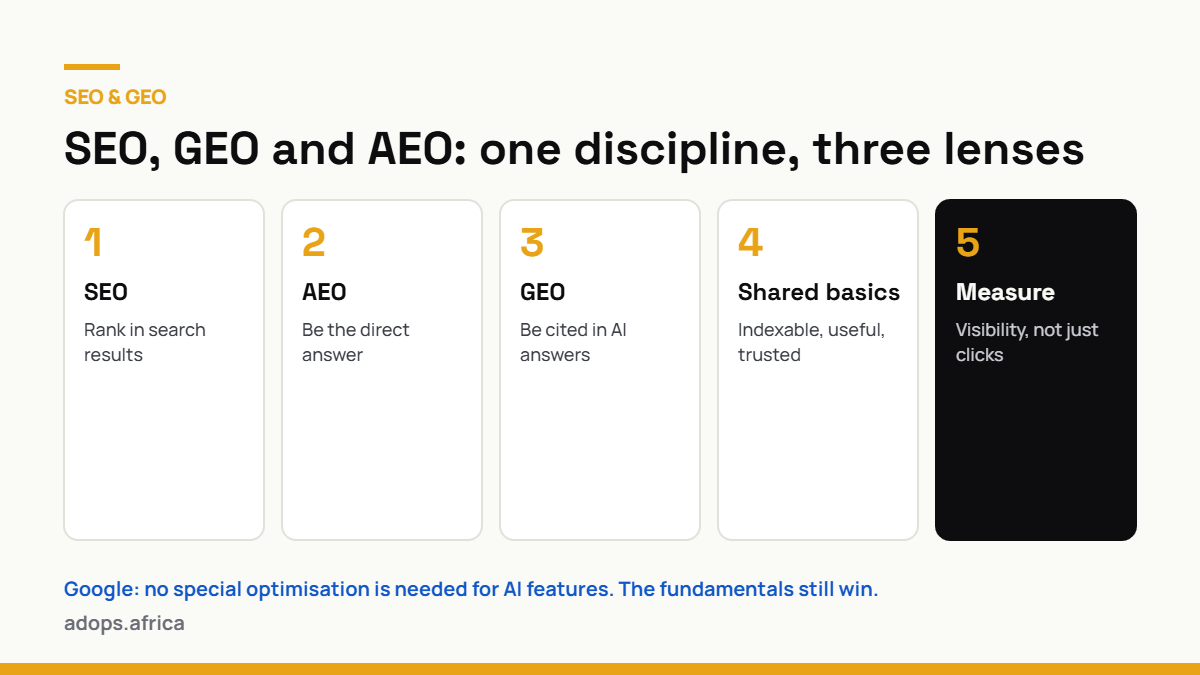
New acronyms arrive faster than new ideas. SEO is search engine optimisation. AEO, answer engine optimisation, is about becoming the direct answer to a question. GEO, generative engine optimisation, is about being cited when an AI tool writes the answer. They overlap far more than the sales pitches suggest, and most of the work is the same. Here’s what each means, what actually changes, and what to do about it.
SEO: being found in search results
The original discipline: making pages crawlable, relevant and trusted, so they rank when people search. It covers technical health, content and links. It hasn’t gone away; it’s the foundation the other two stand on.
AEO: being the answer
As search engines started answering questions directly, through featured snippets, ‘People also ask’ boxes and voice assistants, AEO focused on clear, concise answers to specific questions, usually near the top of a page. If a page answers a question in two sentences, a search engine can quote it.
GEO: being cited by AI
Now Google’s AI Overviews and AI Mode, ChatGPT search and Perplexity write answers from several sources. GEO is about being one of those sources: content that is accurate, specific, well structured and from a source the systems trust.
What Google actually says
Google’s own guidance is plain: to appear in its AI features, a page must be indexed and eligible to show with a snippet, and there are no extra technical requirements or special optimisation needed. In other words, the fundamentals of SEO are the fundamentals of GEO. Our guide to AI Overviews has the detail.
What genuinely changes
- Clicks fall even when visibility rises. If the answer appears on the results page, fewer people click through. You need to measure visibility differently; our search visibility guide shows how.
- Specific beats general. AI answers favour sources with concrete facts, local detail and clear authorship over generic content.
- Your reputation travels. AI tools draw on what others say about you: reviews, news coverage, industry directories. Consistency across them matters.
- Other AI tools have their own rules. ChatGPT, Perplexity and others crawl and cite differently from Google. Check that you’re not blocking their crawlers by accident, if you want to appear there.
Why it matters in Africa
AI answers about African markets often draw on global sources because good local ones are scarce. A clear, well-sourced page on South African, Nigerian or Kenyan prices, rules or market data has a real chance to become the source. That’s an opportunity for local brands and publishers that global competitors can’t easily match.
What to do
- Keep your technical SEO healthy: our technical SEO checklist covers the basics.
- Answer real customer questions clearly, near the top of the page.
- Add specific, local, verifiable detail and name your authors.
- Keep facts consistent across your site, Google Business Profile and directories.
- Track visibility in AI answers alongside traditional rankings.
How to measure success
Track impressions as well as clicks in Search Console, branded search over time, and whether you’re cited when you ask your key questions in Google, ChatGPT and Perplexity each month.
Share with your team
SEO, AEO and GEO are one discipline with three lenses. Google says there’s no special trick for AI features: useful, specific, trusted, crawlable content wins.
Read next: How to show up in AI Overviews and AI answers · How to measure search visibility
Sources
- Google Search Central: AI features and your website
- Google Search Central: Creating helpful, reliable, people-first content
Researched and drafted with AI assistance, then reviewed, fact-checked and edited by Pilira Mwambala. See our Editorial & AI Policy.