



In brief
- South African digital billboards can be bought programmatically through VIOOH, Perion and Broadsign, via DSPs such as DV360.
- The OMC’s ROAD currency and DSP impressions measure different things, so they won’t match.
- Prove outcomes with a geo test, not impression counts.
Programmatic out-of-home (often written pDOOH) lets you buy digital billboard and screen time through the same platforms you use for online display and video. In South Africa the plumbing is in place, but how you buy it and how you measure it both work differently from online media. This explainer covers what’s available, how to buy it, and how to prove it worked.
What’s available in South Africa
Three supply routes connect South African screens to programmatic buyers:
- VIOOH: JCDecaux South Africa launched programmatic sales through VIOOH in late 2023, covering more than 170 digital screens in malls, railway stations, roadside sites and airports across seven provinces. It was VIOOH’s first African market.
- Perion (formerly Hivestack): Hivestack launched a South African marketplace in 2022 with media owners including Primedia Outdoor, Provantage, Tractor Outdoor, Epic Outdoor and Insight Outdoor, ExchangeWire reported. Perion bought Hivestack and retired the brand in 2025.
- Broadsign and Place Exchange: Broadsign announced it was buying Place Exchange in November 2025. ThumbAd, a local reseller, lists Primedia Outdoor, Provantage and Reveel among the owners reachable this way.
On the buying side, Google’s Display & Video 360 supports DOOH deals with Perion, VIOOH, Place Exchange, Magnite, Vistar and Ströer. Google’s help page doesn’t list which countries each seller covers, so confirm South African inventory with the seller before you plan. ThumbAd also reports South African DOOH supply in The Trade Desk.
How you buy it
Programmatic DOOH is mostly bought through deals rather than the open auction. In DV360, Google says every DOOH deal “must be negotiated with the seller”, who then pushes it into the platform. Programmatic guaranteed and non-guaranteed deals are both supported.
- Agree screens, dates, dayparts and price with the media owner or its supply platform.
- Ask the seller to push the deal to your DSP, then attach it to a DOOH line item.
- Upload creative in the formats each network accepts. Screens have fixed sizes, and some only take video.
- Target with what DOOH can actually use: location, time of day, and triggers such as weather where the seller offers them.
Our explainer on supply-path optimisation is worth reading before you choose between routes that reach the same screens.
Why it matters to practitioners
Two things catch buyers out. First, DOOH “impressions” aren’t the same as online impressions: one ad play on a mall screen may be seen by dozens of people, so sellers apply an impression multiplier, their estimate of viewers per play. DV360 reports these as publisher impressions and warns that CPMs in its standard performance view are based on plays, not viewers. Second, the screen has to actually be on. ThumbAd claims a national audit found about a quarter of roadside digital screens weren’t working, which it put down to load-shedding. We haven’t seen the audit itself, but it’s a good reason to ask for proof of play.
How to measure it
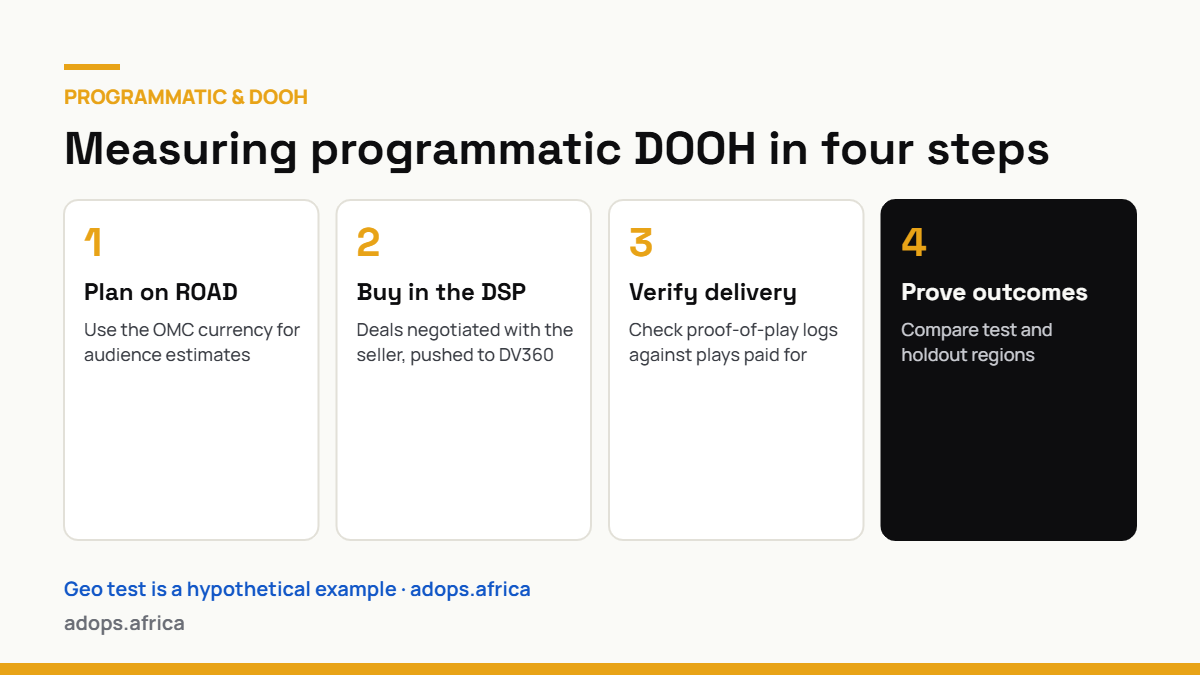
1. Audience: the OMC’s ROAD currency
South Africa’s out-of-home trading currency is ROAD, run by the Out of Home Measurement Council (OMC). Its methodology combines a travel survey by Ask Afrika (more than 71,000 respondents between 2017 and 2024) with HERE road maps and traffic counts. The headline metric is Visibility Adjusted Contacts: the chance that someone passing a site actually looks at it, based on size, distance, speed, angle and lighting. For digital screens, ROAD assumes a five-second ad in a 60-second loop.
Because ROAD estimates people and DSPs report seller-estimated impressions, the two numbers won’t reconcile. Plan on ROAD, buy in the DSP, and report the two side by side rather than trying to force them to match.
2. Delivery: proof of play
Ask the seller or an independent verification partner for proof-of-play logs showing when each ad actually ran on each screen. Compare them with the plays you paid for before you sign off the invoice.
3. Outcomes: a geo test
Hypothetical example: a Gauteng retailer runs DOOH on mall screens in Johannesburg for four weeks and holds back Pretoria, which has similar stores and sales trends. It then compares the change in store sales, branded search and site visits in Johannesburg against Pretoria over the same period. The difference between the two is its estimate of what DOOH added.
For more on why holdout tests beat attribution for channels like this, see attribution vs incrementality.
What to do next
- Ask each media owner which programmatic route its screens are on, and whether your DSP can see them.
- Request ROAD figures for the sites in your plan, and the impression multiplier the seller uses.
- Write proof of play into the deal terms.
- Agree a geo test design with the client before the campaign starts, not after.
Share with your team
We’ll check which programmatic route each of our DOOH suppliers uses, ask for proof of play on every deal, and set up a matched-region test before our next out-of-home flight.
Read next: Supply-path optimisation, explained · Attribution vs incrementality · DV360 campaign QA
Sources
- Google: Purchase digital out-of-home inventory, Display & Video 360 Help
- OMC: OOH Audience Research Methodology, release 2024.4
- VIOOH: JCDecaux South Africa programmatic DOOH partnership (30 Nov 2023)
- ExchangeWire: Hivestack launches programmatic DOOH marketplace in South Africa (25 Jul 2022)
- Invidis: Hivestack brand retired, capabilities rolled into Perion (27 Feb 2025)
- Business Wire: Broadsign announces acquisition of Place Exchange (24 Nov 2025)
- ThumbAd: Programmatic DOOH South Africa market briefing (reseller; commercial interest)
Researched and drafted with AI assistance, then reviewed, fact-checked and edited by Pilira Mwambala. See our Editorial & AI Policy.



