



In brief
- Measure email in three layers: deliverability, engagement and revenue. Each needs different metrics.
- Open rates are no longer reliable, and Gmail and Yahoo now set firm rules for bulk senders.
- In South Africa, POPIA section 69 decides who you may email at all.
Email is one of the few channels you own outright. But most email reports still lead with the open rate, a number that has become far less reliable since 2021. Here’s a measurement framework that connects deliverability, engagement and revenue, so you can tell whether email is actually earning its keep.
Why should you care?
Two changes reshaped email measurement. First, Apple’s Mail Privacy Protection downloads remote content, including tracking pixels, in the background by default, so senders can’t tell when, or whether, someone opened an email. Opens from those users look like opens whether they read the email or not.
Second, since February 2024 Gmail and Yahoo have required bulk senders to authenticate their mail, keep spam complaints low and offer one-click unsubscribe. Miss those rules and your email may not reach the inbox at all, however good the content.
The three layers
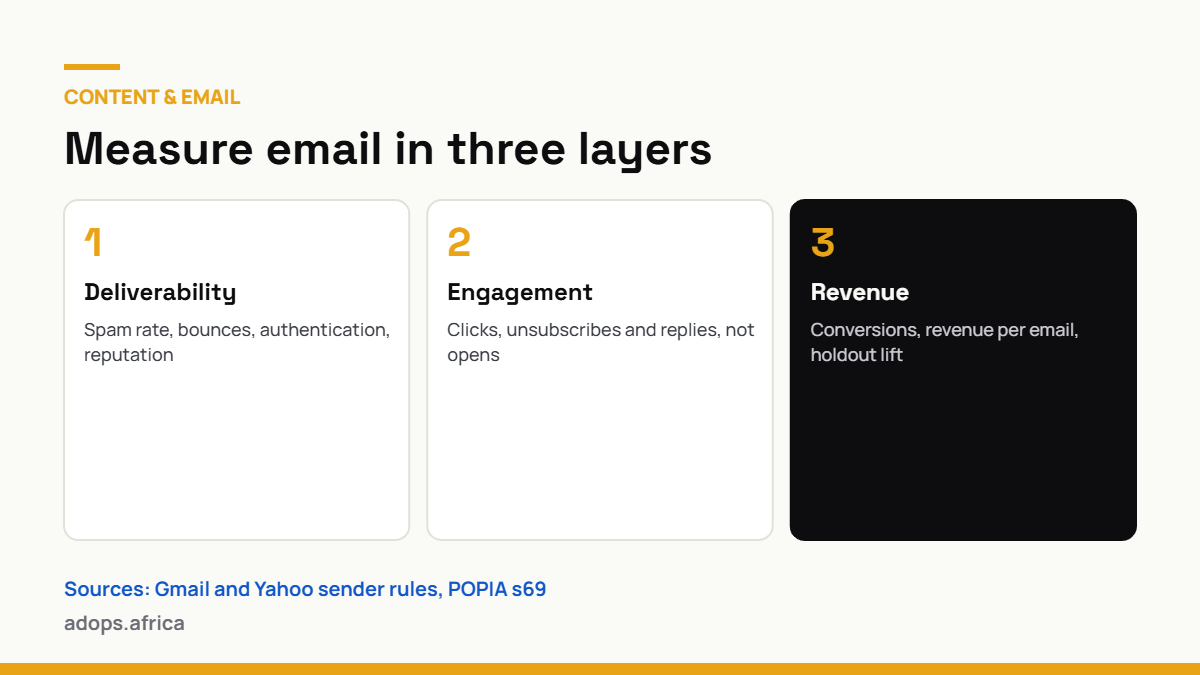
| Layer | What it answers | Key metrics |
|---|---|---|
| Deliverability | Did it reach the inbox? | Delivery rate, bounce rate, spam complaint rate, domain reputation |
| Engagement | Did people act on it? | Click rate, click-to-delivered rate, unsubscribe rate, replies |
| Revenue | Did it make money? | Conversions, revenue per email delivered, revenue per subscriber, incremental lift |
Layer 1: deliverability
Google’s sender guidelines apply to everyone sending to personal Gmail accounts. All senders need SPF or DKIM, and a spam rate in Postmaster Tools below 0.30%; Google’s advice is to stay below 0.10%. If you send 5,000 or more messages a day to Gmail, you also need both SPF and DKIM, a DMARC policy (even “none” is enough), alignment between your From domain and SPF or DKIM, and one-click unsubscribe plus a visible unsubscribe link in marketing emails. Yahoo sets the same core rules and asks senders to process unsubscribes within two days.
- Ask your email platform or IT team to confirm SPF, DKIM and DMARC are set up for your sending domain.
- Register your domain in Google Postmaster Tools and check spam rate and reputation weekly.
- Track hard bounces and remove them immediately.
Layer 2: engagement
Treat opens as a rough trend at best. Report clicks instead: click rate on delivered emails, unsubscribe rate and, for B2B, replies. Use engagement to keep your list healthy: if someone hasn’t clicked in months, try a re-engagement email, then stop sending to them. Mailing people who never engage pushes up complaints and hurts deliverability for everyone else.
Layer 3: revenue
- Tag every link. Use consistent UTMs so GA4 attributes sessions and conversions to email, following your campaign tracking plan.
- Connect to the CRM. Match orders or qualified leads back to subscribers to calculate revenue per subscriber, not just per send.
- Report revenue per email delivered. It lets you compare a weekly newsletter with an automated journey fairly.
- Hold out a control group. Withhold a campaign from a small random group to see how much revenue email really adds. Our explainer on attribution vs incrementality covers why.
A simple monthly routine
- Week 1: check Postmaster Tools for spam rate, domain reputation and authentication errors, and remove hard bounces.
- Week 2: review click rate, unsubscribes and revenue per email delivered by campaign and by automated journey.
- Week 3: send a re-engagement email to subscribers who haven’t clicked recently, then suppress those who still don’t respond.
- Week 4: check one holdout test result and agree one change for next month.
What does it mean in African markets?
In South Africa, section 69 of POPIA governs electronic direct marketing. You need prior consent to email people who aren’t customers. The exception for existing customers only applies if you got their details during a sale, you’re marketing your own similar products or services, and you gave them a chance to opt out when you collected the details and in every message since. The Information Regulator published a guidance note on direct marketing in December 2024. Other markets have their own rules, so check locally before you import a list.
Most subscribers read on mobile, often on paid data. Keep emails light: compressed images, short copy and one clear call to action. A heavy email that loads slowly gets fewer clicks.
How do you measure success?
- Spam complaint rate below 0.10% in Postmaster Tools.
- Click rate and revenue per email delivered trending up.
- List growth that comes only from consented sources.
- Measurable incremental revenue from holdout tests.
Share with your team
We’ll stop leading email reports with open rates. Every report should show deliverability (spam rate and bounces), engagement (clicks and unsubscribes) and revenue per email delivered, and every list we mail must meet POPIA’s consent rules.
Read next: The campaign tracking plan · POPIA and cookies in South Africa
Sources
- Gmail Help: Email sender guidelines
- Yahoo Sender Hub: Sender best practices
- Apple: Mail Privacy Protection & Privacy
- Information Regulator: Guidance note on direct marketing in terms of POPIA (December 2024)
- Google Postmaster Tools
Researched and drafted with AI assistance, then reviewed, fact-checked and edited by Pilira Mwambala. See our Editorial & AI Policy.



