



In brief
- Smart Bidding learns from your conversions, so it’s only as good as your tracking and volume.
- On small budgets, start with Maximise conversions and move to targets once data builds up.
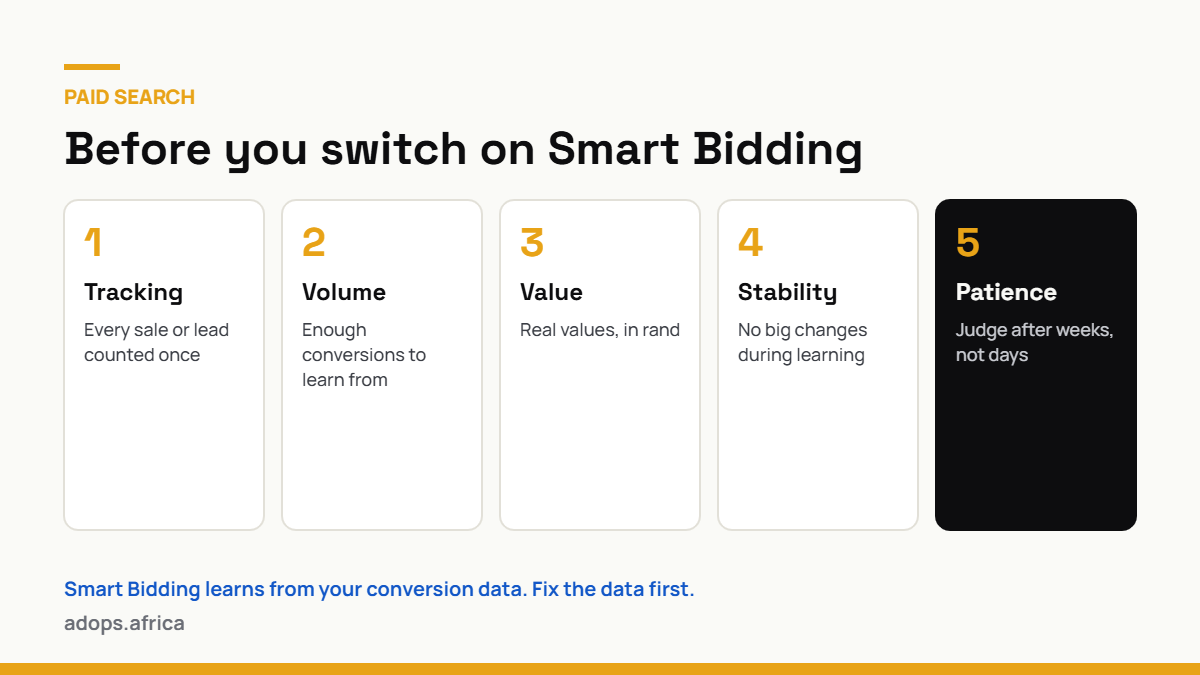
- Fix tracking, use real values, avoid big changes while it learns, and judge over weeks.
Smart Bidding is Google’s automated bidding: it sets a bid for every auction based on how likely that search is to convert. On big accounts it usually beats manual bidding. On the small budgets many African advertisers work with, it can just as easily optimise towards the wrong thing, or not learn at all. Here’s what must be right before you hand over the controls.
The four main strategies
- Maximise conversions: get as many conversions as possible within the budget.
- Maximise conversion value: the same, but for value, such as revenue.
- Target CPA: get conversions at or near a cost per acquisition you set.
- Target ROAS: get value at or near a return on ad spend you set.
The ‘maximise’ strategies spend the budget and learn as they go. The ‘target’ strategies need enough history to know what a conversion costs, which is where small accounts struggle.
1. Tracking must be right
Smart Bidding treats every conversion you report as the truth. If a sale is counted twice, if a ‘lead’ fires when someone opens a form rather than submits it, or if the conversion value is in the wrong currency, the system will chase those signals faithfully. Test the whole journey first: our click-to-conversion testing guide shows how. Use one primary conversion per goal, and make sure it reflects real business value.
2. You need enough conversions
Google doesn’t set a hard minimum, but the more conversions a campaign gets, the better the bidding works. Practitioners commonly suggest Target CPA works best from around 30 conversions a month and Target ROAS from around 50. Below that, results swing.
If you don’t have the volume, there are options:
- Start with Maximise conversions and a sensible budget, then add a target later.
- Pool data by grouping similar campaigns into one portfolio bid strategy, or by consolidating campaigns.
- Optimise to an earlier step, such as a qualified lead rather than a closed sale, if it happens more often and still predicts revenue.
- Import offline conversions if sales close by phone or in a branch, so Google learns which leads actually buy.
3. Use real values
For value-based bidding, send the actual order value, in rand or your account currency. For lead generation, assign different values to different lead types if some are worth more. A flat value for everything teaches the system that all leads are equal.
4. Keep things stable while it learns
After you launch or change a strategy, the status shows ‘Learning’ while the system adjusts. Big changes to budget, targets or conversion settings restart that process. Change targets gradually, by 10 to 20% at a time, and avoid changing several things at once.
If tracking breaks for a few days, use Google’s data exclusions so the bad data doesn’t distort bidding. For short, predictable spikes such as a flash sale, seasonality adjustments tell the system to expect a jump in conversion rates.
Why it matters in Africa
Many African accounts run on budgets where a handful of conversions a week is normal. That’s not a reason to avoid Smart Bidding, but it does mean the basics matter more: one wrong conversion action can be a large share of the data. Consent also matters: when visitors decline cookies, fewer conversions are observed, and Google relies more on modelling. Our Consent Mode guide explains how to keep that signal as complete as possible.
How to measure success
Judge Smart Bidding over four to six weeks, on the business result: cost per sale or lead in your own CRM, not just in Google Ads. Compare with the period before, allowing for seasonality, and watch the search terms to see what it’s buying.
Share with your team
Smart Bidding is only as good as the data it learns from. Fix tracking, send real values, build volume, and don’t change targets while it’s learning.
Read next: The search terms report routine · Performance Max vs Search in low-volume African markets
Sources
- Google Ads Help: About bid strategy statuses
- Google Ads Help: About Target ROAS bidding
- Search Engine Land: Everything you need to know about Target CPA bidding
Researched and drafted with AI assistance, then reviewed, fact-checked and edited by Pilira Mwambala. See our Editorial & AI Policy.



