



In brief
- Larridin is a US platform that measures whether a company’s AI tools are used and paying off.
- Its own survey found leaders confident in AI’s value but unable to prove it.
- You can start measuring AI return in your team now, with or without a platform.
Your team probably pays for ChatGPT, Claude, Gemini, a design tool with AI built in, and an AI feature in your ad platform. Ask your finance director what all that returns, and most marketing leads go quiet. Larridin is one of a new group of companies built to answer that question.
What Larridin is
Larridin is a US software company that measures AI adoption and return across an organisation. It is led by Russ Fradin, an ad tech veteran who founded Adify (sold to Cox in 2008) and Dynamic Signal. It raised US$17 million in a round led by Andreessen Horowitz (a16z), with Bloomberg Beta and Gradient Ventures.
It isn’t a marketing tool as such. It measures AI use across every department, and marketing and digital teams are among them. Its platform covers four areas:
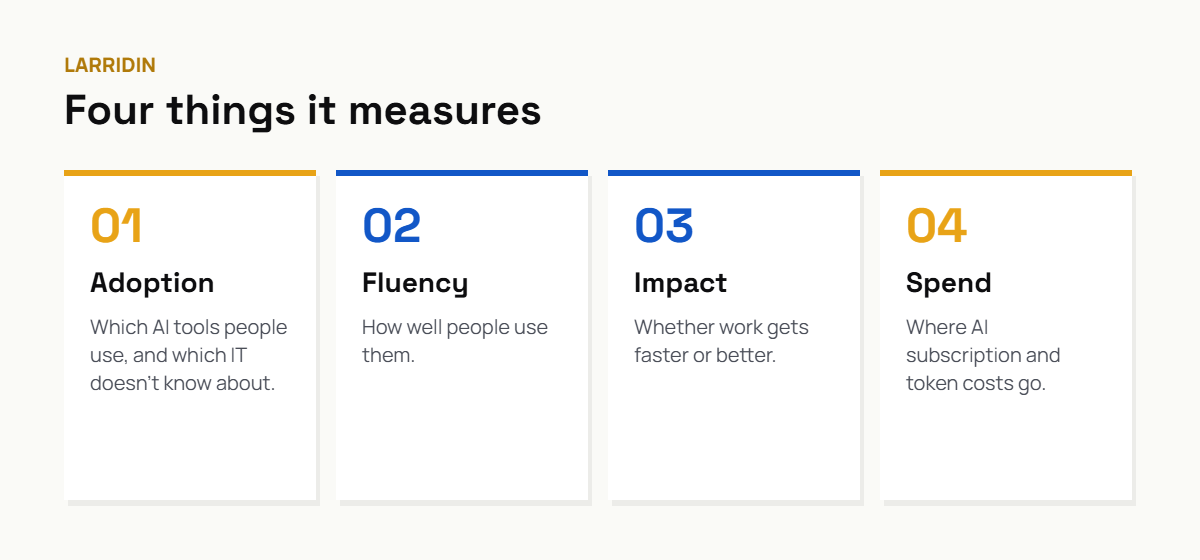
The problem it’s built for
AI tools spread faster than anyone tracks them. Larridin’s 2026 State of Enterprise AI survey of 365 senior leaders at large companies found an average of 23 AI tools per organisation, and 62% of companies had no full list of the AI applications in use. Yet 92% of executives said they were fully confident in AI’s impact, and three-quarters expected a return within six months.
Two cautions. Larridin commissioned that survey, and sells the fix for the problem it describes. And a later study it ran with Carnegie Mellon University found that only one signal, how concretely companies described their AI use in annual reports, linked to revenue growth, and none linked to margins. Proving AI’s value is still hard, for everyone.
Why it matters in Africa
- AI is priced in dollars. Subscriptions and token costs move with the exchange rate, so unmeasured AI spend is also an unmanaged currency risk.
- Agencies sell time. If AI saves hours, clients will ask for it in fees. You need your own numbers before they bring theirs.
- Monitoring staff has rules. Tools that track how employees use AI collect personal information. Under POPIA, staff must know what’s collected and why.
- Most local teams are small. An enterprise platform may be more than you need; the discipline it represents is not.
What you can do now
- List every AI tool your team uses, paid and free, with an owner for each.
- Track the cost in rand, monthly, per tool and per team.
- Baseline three tasks before and after AI: for example, campaign set-up time, report turnaround and errors caught in QA.
- Agree an AI policy: which tools are approved, what data may go into them, and who reviews the output.
- If you evaluate a platform like Larridin, ask what employee data it collects, where it’s stored, how it meets POPIA, and what it costs in rand.
Larridin isn’t a standards body, so there’s nothing to join. But the question it raises belongs to every team: what is our AI actually returning? We’d like to know how African marketing teams answer it. Tell us at editor@adops.africa.
Ad Ops Africa has no commercial relationship with Larridin.
Read next: Project Eidos, explained: what the IAB is building and what African teams should do
Sources
- Larridin: The Larridin story
- PMF Show: Larridin raised $17M from a16z (interview with Russ Fradin)
- Business Wire: Larridin 2026 State of Enterprise AI report (3 February 2026)
- Larridin and Carnegie Mellon University: AI adoption and revenue growth study (August 2026)
Researched and drafted with AI assistance, then reviewed, fact-checked and edited by Pilira Mwambala. See our Editorial & AI Policy.



