


In brief
- Performance Max needs steady conversion data, which many African accounts don’t have.
- Keep brand and core keywords in Search; test PMax for reach once you have volume.
- Use the 2025 reporting and negative keyword controls to see where PMax spends.
Performance Max (PMax) promises to find customers across all of Google, from Search and YouTube to Display, Discover, Gmail and Maps, from one campaign. For a big retailer with thousands of conversions a month, it often delivers. For a Nairobi software company with 40 leads a month, or a Durban clinic with a R15,000 budget, the picture is different. Here’s how to decide, and how to test without wasting budget.
How the two differ
| Search | Performance Max | |
|---|---|---|
| Where ads show | Google Search (and partners, if on) | All Google channels |
| What you control | Keywords, match types, ad copy, bids | Goals, assets, audience signals, exclusions |
| What it needs | Good keyword research | Steady conversion data and strong assets |
| Visibility | Full search terms and keyword data | Improved in 2025, still less granular |
PMax is built on machine learning, and machine learning learns from conversions. The fewer conversions an account has, the longer PMax takes to learn, and the more it may spend on cheaper placements, such as Display, that look good in-platform but don’t move the business.
When PMax helps, and when it hides waste
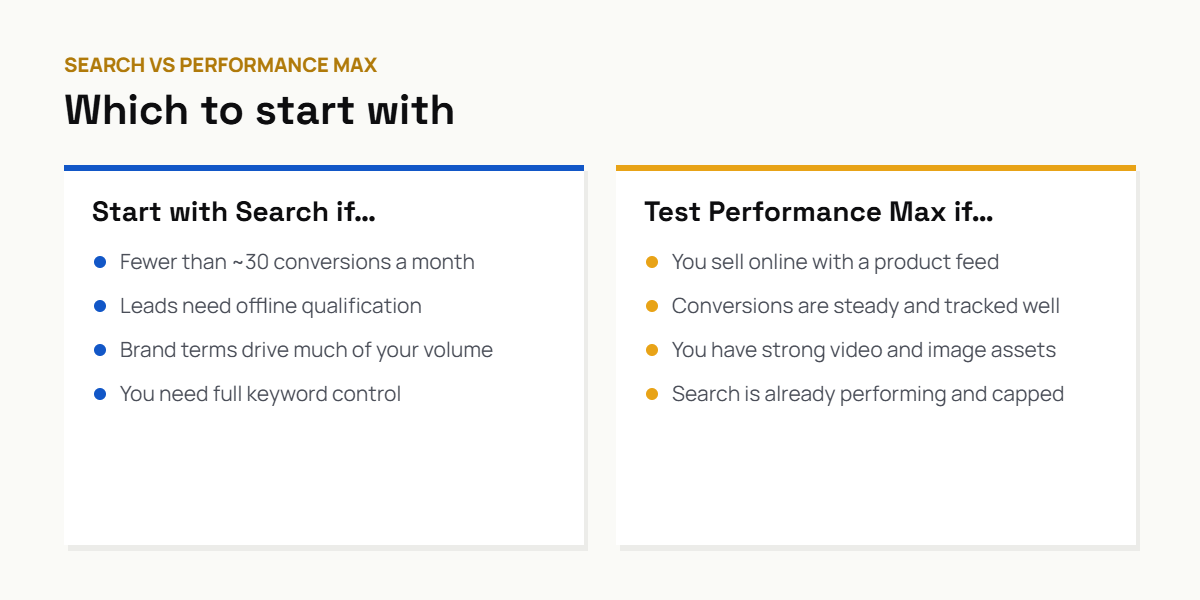
PMax tends to work for e-commerce with a product feed, accounts with dozens of conversions a month or more, and brands with good video and image assets. In those cases it can find buyers that keyword lists miss.
PMax tends to struggle where conversions are few or slow (B2B, property, financial services), where most “conversions” are form fills that never become customers, and where it quietly takes over branded searches you’d have won cheaply in Search.
What changed in 2025
Google gave advertisers more control and visibility over PMax during 2025:
- Campaign-level negative keywords, with the account limit raised to 10,000 in March 2025.
- Channel performance reporting (April 2025): see spend and results by Search, YouTube, Display and other channels.
- Full search terms reporting, so you can see what PMax actually matched to.
- Demographic exclusions and device targeting, now generally available.
Google also launched AI Max for Search in 2025, which brings PMax-style matching and automatically generated ad text into Search campaigns. That gives you a middle option: more automation, while keeping Search reporting.
A test plan for smaller accounts
- Fix measurement first. Track the conversions that matter (sales or qualified leads), not page views. Import offline sales or lead quality if you can. PMax optimises to whatever you tell it to.
- Protect your brand. Keep brand keywords in their own Search campaign, and add brand exclusions to PMax so it doesn’t take credit for searches you’d win anyway.
- Run a split test. Move 20–30% of budget to PMax for 6–8 weeks. Keep Search running. Use Google’s experiments feature if available, or compare like-for-like periods.
- Judge on business results. Compare cost per qualified lead or sale, not in-platform conversions. Check the channel report: if most spend went to Display, ask whether that’s what you wanted.
- Add negatives early. Review search terms weekly for the first month and exclude irrelevant ones.
- Decide with data. If PMax beats Search on real outcomes, scale it gradually. If not, try AI Max for Search instead.
The honest answer for most African accounts today: Search first, PMax as a measured test once conversion tracking is solid and volume is steady. Automation is only as good as the data you give it.
Read next: How to show up in AI Overviews and AI answers · Meta’s new AI ad tools: what African advertisers can use now
Sources
- Google Ads Help: About Performance Max campaigns
- Google Africa Blog: New Performance Max features (January 2025)
- PPC Land: Google wraps up Performance Max feature rollouts in 2025
- Dotidot: AI Max for Search explained
Researched and drafted with AI assistance, then reviewed, fact-checked and edited by Pilira Mwambala. See our Editorial & AI Policy.