



In brief
- Clicks and cheap conversions are easy to buy; profitable customers are not.
- Track the outcome the business counts, give it a real value, and feed back sales from your CRM.
- Then let value-based bidding chase that outcome, and judge it in your own sales data.
Most Google Ads accounts are built around what Google can easily see: clicks, form fills, add-to-carts. Most businesses are run on something else: sales, qualified leads, margin. When the two don’t match, Smart Bidding gets very good at buying the wrong thing. Here’s how to build a campaign around the business outcome instead.
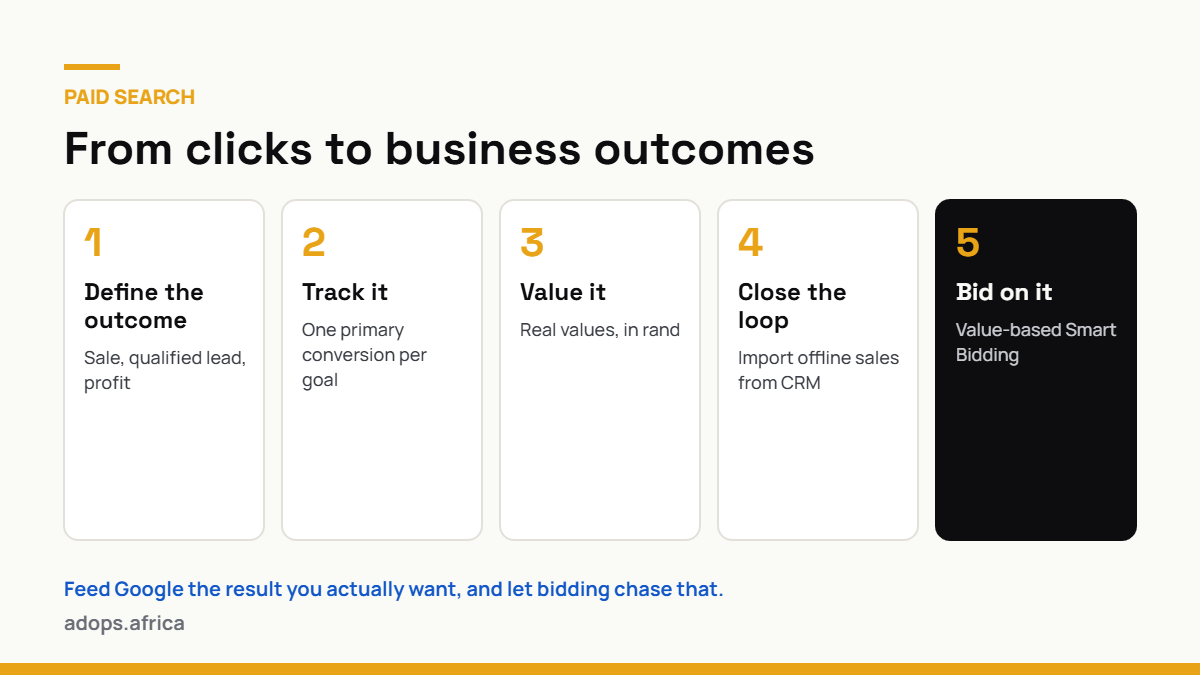
1. Define the outcome
Start with one sentence: what does a successful click lead to? For an online shop, a paid order. For a bank or insurer, a qualified application, not just a form start. For a B2B firm, a sales meeting with the right kind of company. Write it in the brief, with a target cost or return, before anyone opens Google Ads.
2. Track that outcome
Set one primary conversion action per business goal and make everything else secondary. Secondary actions, such as page views or calls under 30 seconds, still show in reports but don’t steer bidding. Our conversion tracking QA guide covers the settings that matter, and our click-to-conversion test shows how to check it works.
3. Give it a real value
Send the actual order value for e-commerce, in rand or your account currency. For lead generation, estimate what each lead type is worth: if one in five qualified leads becomes a R10,000 sale, a qualified lead is worth about R2,000 in revenue. Different products or lead types should carry different values, or bidding treats them as equal.
4. Close the loop with your CRM
For many African businesses, the sale happens later: on the phone, in a branch, through a broker. Google can’t see that unless you tell it. Offline conversion import, and the simpler option Google calls enhanced conversions for leads, let you send closed sales back from your CRM, matched to the original click. Bidding then learns which searches produce customers, not just enquiries.
Before you send customer data, make sure your privacy policy covers it and that the data is hashed before it leaves your systems, as Google’s tools do. Under POPIA, you remain responsible for it.
5. Bid on the outcome
Once you’re tracking real outcomes with real values, value-based Smart Bidding (Maximise conversion value, then Target ROAS) can chase the most valuable customers rather than the cheapest clicks. On small accounts, start with Maximise conversions or Maximise conversion value and add a target once you have enough data; our Smart Bidding guide explains the thresholds.
Structure the account around outcomes too
- Separate brand and non-brand. Brand searches convert cheaply and can flatter results. Keep them in their own campaign so you can judge non-brand on its own merits.
- Group by margin, not just product. Products with very different margins or lead values belong in different campaigns, so budgets follow profit.
- Keep it simple. Fewer, larger campaigns give bidding more data. Split only when the goal, budget or value differs.
A quick (hypothetical) example
A Johannesburg insurer counts every quote request as a conversion worth R100. Google Ads reports a healthy cost per conversion, but sales say most quotes never buy. The team imports closed policies from the CRM, values them at the first year’s premium, and switches the quote form to secondary. Within two months, bidding shifts towards the searches that produce policyholders, and cost per policy falls, even though ‘conversions’ in Google Ads go down.
A quick example
A Johannesburg insurer counts every quote request as a conversion worth R100. Google Ads reports a healthy cost per conversion, but sales say most quotes never buy. The team imports closed policies from the CRM, values them at the first year’s premium, and switches the quote form to secondary. Within two months, bidding shifts towards the searches that produce policyholders, and cost per policy falls, even though ‘conversions’ in Google Ads go down.
Why it matters in Africa
Many African sales journeys are slow and offline: a search, a WhatsApp chat, a call, a visit to a branch. Accounts that stop measuring at the form fill end up optimising for enquiries that never buy. Closing the loop takes some set-up, but on smaller budgets it’s often the single biggest improvement you can make.
Common mistakes
- Every action is primary. Page views, clicks on a phone number and sales all count equally, so bidding chases the easiest.
- One value for every lead. A R500 enquiry and a R50,000 enquiry look identical to the algorithm.
- Judging on Google’s numbers only. The real test is revenue and qualified leads in your own system.
How to measure success
Track cost per qualified lead or sale, and return on ad spend, from your CRM or sales system, monthly. Compare with the same months before the change. If Google reports more conversions but the business sees no more customers, the conversion setup still isn’t measuring the outcome.
Share with your team
Build Google Ads around what the business counts: one primary outcome, a real value, closed sales fed back from the CRM, and value-based bidding on top.
Read next: Smart Bidding and small budgets · Google Ads conversion tracking QA
Sources
- Google Ads Help: An easier way to import offline conversions (enhanced conversions for leads)
- Google Ads Help: Set up conversion tracking for your website
- Google Ads Help: About Target ROAS bidding
Researched and drafted with AI assistance, then reviewed, tested and edited by Pilira Mwambala. See our Editorial & AI Policy.