



In brief
- Google says AI Overviews need no special optimisation: pages must be indexed and snippet-eligible.
- AI clicks appear in Search Console’s normal Web report, with no separate breakdown.
- Answer clearly, keep facts consistent, earn local mentions, and track your key questions monthly.
More searches now end with an AI-written answer at the top of the page: Google’s AI Overviews and AI Mode, ChatGPT search, Perplexity. For African brands and publishers, the question is simple: when someone asks about your category, does the answer mention you? Here’s what Google actually says, and what you can do about the rest.
What Google says
Google’s guidance, last updated in December 2025, is plainer than most “GEO” advice. To appear in AI Overviews or AI Mode, a page must be indexed and eligible to show in Search with a snippet. Google says there are no extra technical requirements and no special optimisation, schema or AI-specific files needed.
Clicks from AI features count in Search Console’s normal Performance report, under the Web search type. There is no separate AI report, so you can’t yet isolate that traffic there.
In other words: the fundamentals are the strategy. Anyone selling a secret AI Overviews hack is selling something Google says doesn’t exist.
What helps, in practice
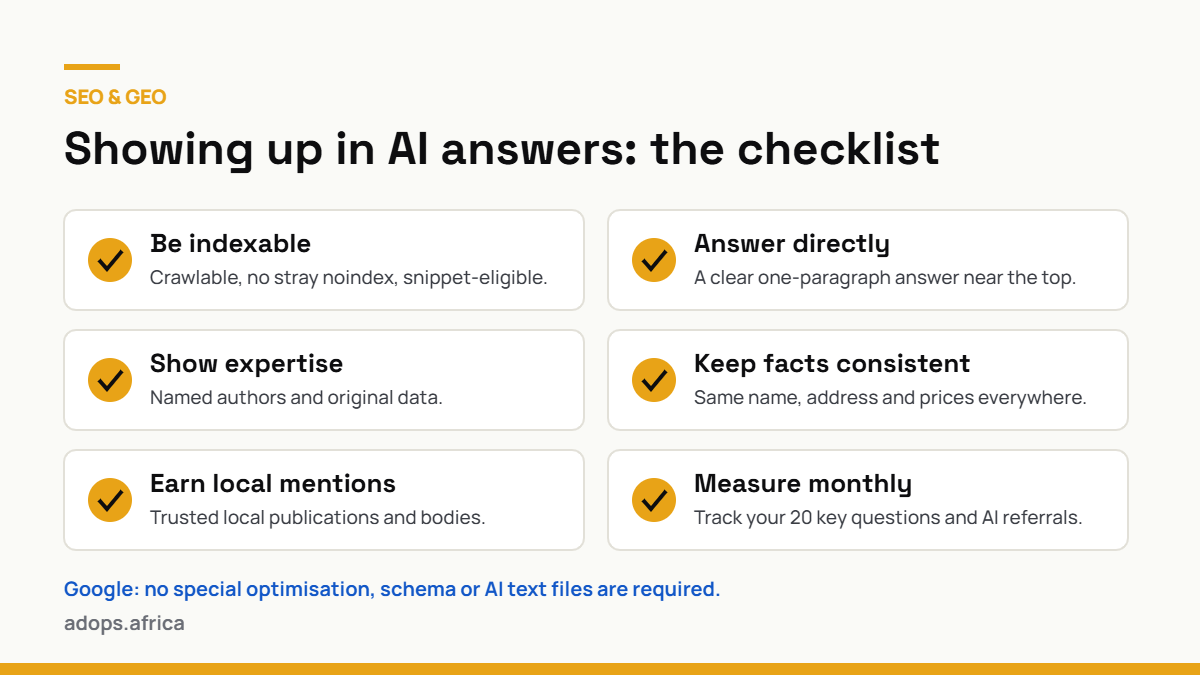
- Be indexable. Check that Googlebot can crawl your key pages (robots.txt, no accidental noindex) using Search Console’s URL Inspection tool.
- Answer the question directly. Put a clear, one-paragraph answer near the top of the page, then the detail. AI systems summarise what’s easy to quote.
- Show real expertise. Named authors, first-hand experience, original data. Our Digital 2026 data story is an example: specific numbers, clearly sourced.
- Keep facts consistent. Your name, address, prices and services should match on your site, Google Business Profile, LinkedIn and directories. Conflicting facts make you harder to cite.
- Earn local mentions. Coverage in trusted South African, Nigerian or Kenyan publications and industry bodies is what AI answers draw on for local questions.
- Keep structured data honest. It isn’t required, but if you use it, it must match what’s visible on the page.
Why it matters in Africa
AI answers are only as local as their sources. For many African questions, the best-indexed sources are global sites, so answers default to US or UK examples. Brands and publishers that document local prices, regulations and market data clearly have a real chance to become the source AI answers cite.
Language matters as well. Questions asked in isiZulu, Kiswahili, Hausa or Pidgin have far fewer good sources to draw from. A clear page in the language your customers search in may face little competition at all.
Your choices about AI use
If you’d rather limit how your content is used, Google lists the controls: nosnippet, data-nosnippet and max-snippet limit what’s shown, and the Google-Extended setting in robots.txt limits use for training other Google AI systems. Weigh it carefully: limiting snippets can also limit your visibility in AI answers.
Three myths to ignore
- “You need an llms.txt file.” Google says no special AI text files are needed for its AI features. Other AI companies may read them, but they aren’t a requirement for Google.
- “Schema guarantees a citation.” Structured data helps Google understand a page. It doesn’t buy a place in an AI answer.
- “Write for robots.” Pages stuffed with question-and-answer filler read badly to people and gain nothing. Google’s own advice is content made for people first.
Seeing fewer visits in GA4 than you expect? Our Consent Mode guide explains how consent choices change what GA4 records.
How to measure it
- Track your questions. List the 20 questions your customers ask. Once a month, ask them in Google, ChatGPT and Perplexity and note whether you’re mentioned or linked.
- Watch referrals. In GA4, check traffic from chatgpt.com, perplexity.ai and similar referrers.
- Watch impressions vs clicks. Rising impressions with falling clicks in Search Console often means answers are being given on the results page.
Read next: 10 AI prompts every media planner should save
Sources
Researched and drafted with AI assistance, then reviewed, fact-checked and edited by Pilira Mwambala. See our Editorial & AI Policy.



