



In brief
- The same impression often reaches you through several resellers, each taking a fee.
- Supply-path optimisation means buying through fewer, cleaner, cheaper routes.
- Start with ads.txt, sellers.json and your DSP’s supply-path reports.
When you buy a banner on a South African news site through a demand-side platform (DSP), you might assume there’s one route from your budget to the page. There rarely is. The same impression can be offered by the publisher’s own supply-side platform (SSP), by a reseller, and by a reseller of a reseller, each taking a cut. Supply-path optimisation (SPO) is how buyers cut through that.
What a supply path is
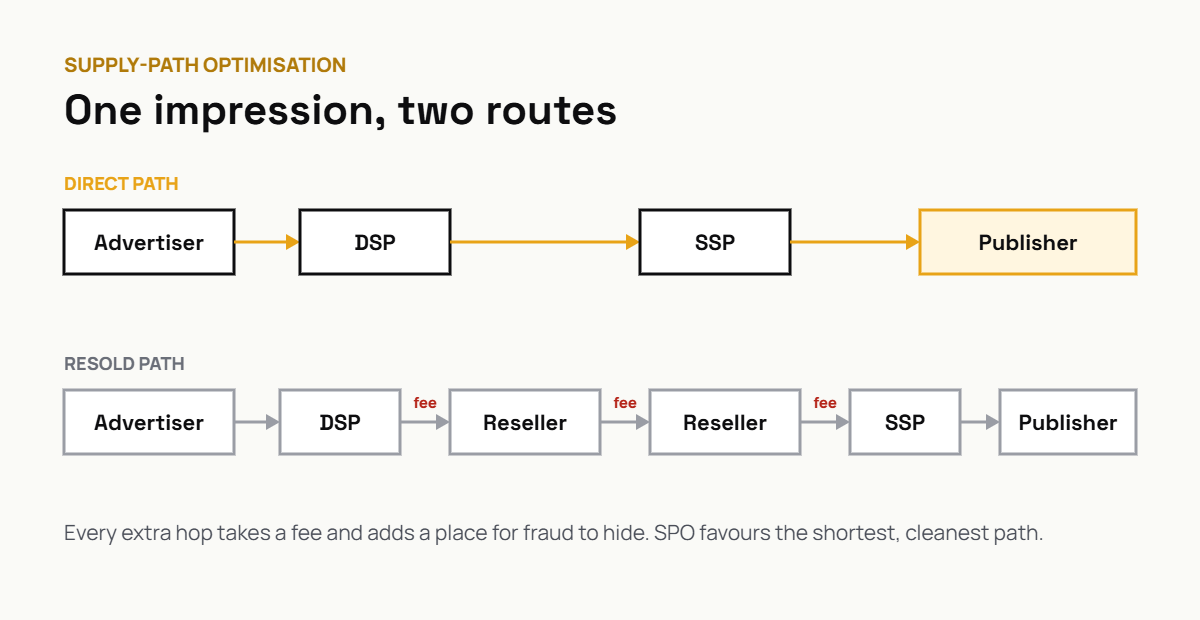
A supply path is every company between your DSP and the publisher’s page. A direct path might be DSP → SSP → publisher. A resold path adds one or two intermediaries. Every hop takes a fee, adds a chance of fraud, and makes it harder to see where your money went.
The scale is real. In the UK, the ISBA and PwC supply-chain study of 2020 found that publishers received only about half of what advertisers spent, and around 15% of spend couldn’t be traced at all. More recent ANA benchmarking in the US shows quality-led advertisers getting 56.7% of programmatic spend through to fraud-free, viewable impressions, against 37.5% for the rest.
Why it matters more in Africa
- Fewer local SSP relationships. Many African publishers sell programmatically through a global SSP or a reseller, so paths are often longer than they need to be.
- Smaller budgets feel fees more. A few extra percentage points on a R200,000 campaign is money that could have bought reach.
- Fraud hides in long chains. The more resellers, the easier it is for low-quality or spoofed inventory to slip in.
The three tools that make SPO possible
These are all IAB Tech Lab standards, and they’re free:
- ads.txt: a public file on the publisher’s site listing who may sell its inventory, marked DIRECT or RESELLER.
- sellers.json: a file each SSP publishes, naming the sellers it works with and whether they are publishers or intermediaries.
- SupplyChain object (schain): data sent with every bid request listing each company that handled it.
Together they let you see the full path behind each impression, and choose the shortest one.
How to start, this month
- Check your top publishers’ ads.txt. Open publisher.co.za/ads.txt for your ten biggest sites. Note which SSPs are listed as DIRECT.
- Pull your DSP’s supply-path or SSP report. See how much you’re buying through each SSP for those same sites.
- Prefer direct paths. Where an SSP is DIRECT for a publisher, favour it over resellers in your targeting or deals.
- Move key publishers into deals. Private marketplace (PMP) or programmatic guaranteed deals fix the path and the price. In the ANA’s Q4 2025 benchmark, PMPs accounted for about 92% of median spend.
- Review every quarter. Paths change as publishers add and drop partners.
SPO isn’t about cutting every intermediary. Some resellers add real value, such as specialist video supply. It’s about knowing who’s in the chain and paying only for the ones who earn their place.
Read next: Project Eidos, explained: what the IAB is building and what African teams should do · Performance Max vs Search in low-volume African markets
Sources
- News Media Association: ISBA programmatic study, publishers receive half of advertiser spend (May 2020)
- IAB Tech Lab: sellers.json
- ANA: Q4 2025 Programmatic Transparency Benchmark (February 2026)
- Trade House Media: sellers.json and the SupplyChain object explained
Researched and drafted with AI assistance, then reviewed, fact-checked and edited by Pilira Mwambala. See our Editorial & AI Policy.



