



In brief
- Video reports full of views and completion rates show delivery, not whether the campaign worked.
- Report five layers: delivery, viewability, attention, response and business result.
- Agree the business measure before launch, and use lift studies or holdouts where budgets allow.
A video campaign report lands: 2 million impressions, 70% completion rate, 0.4% click-through rate. Everyone nods. But did anyone buy anything, search for the brand, or remember it next week? Completed views are delivery metrics. Here’s how to report video properly.
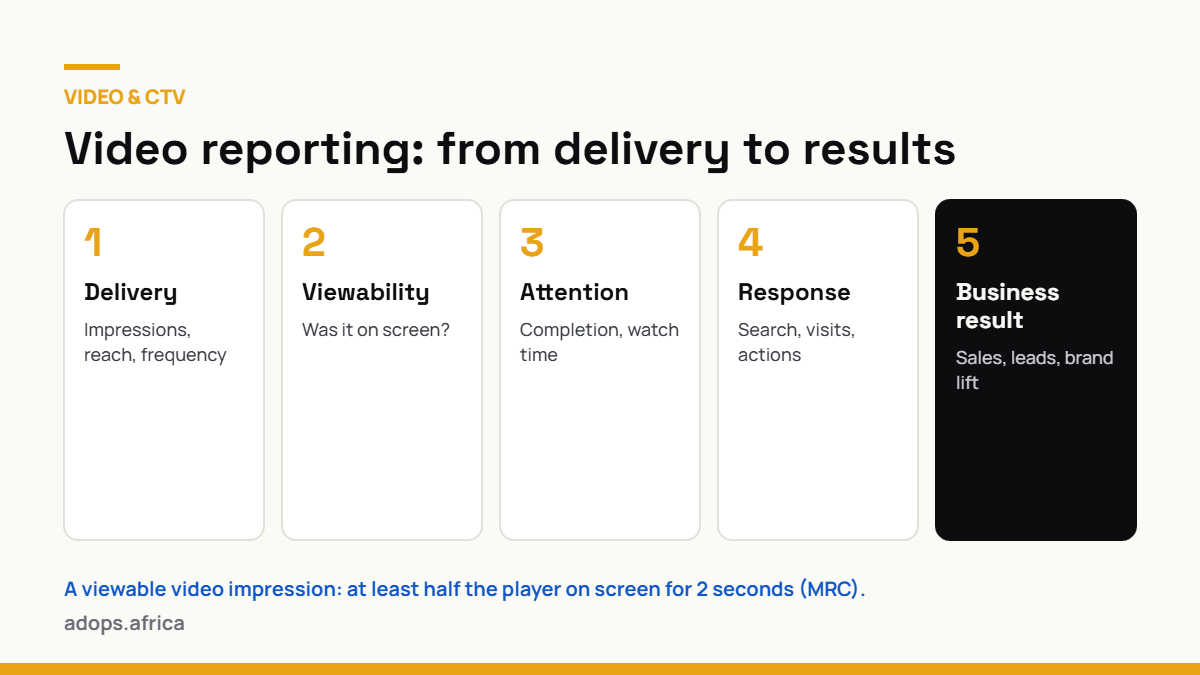
1. Delivery
Impressions, reach and frequency: did the campaign reach enough of the right people, often enough but not too often? Reach in the target audience matters more than total impressions, and a high frequency in a small audience can make a big impression count look better than the campaign really was.
2. Viewability
An impression only counts if it could be seen. The industry standard, set by the Media Rating Council, counts a video impression as viewable when at least half the player is on screen for at least two continuous seconds. Use a verification tool, or the platform’s own measure such as Google’s Active View, and report the viewable rate alongside impressions.
3. Attention
Completion rate and average watch time show whether people stayed. Be careful comparing platforms: a ‘view’ means different things in different places, and skippable and non-skippable formats aren’t comparable. A 6-second bumper will always ‘complete’ more than a 30-second ad.
4. Response
What did people do afterwards? Look at branded search, site visits, app installs and engagement in the days after exposure. Clicks on video ads are a weak signal, because most people don’t click a video they enjoyed; they search later.
5. Business result
Sales, leads or measurable brand lift. Platforms such as YouTube offer brand lift studies that compare people who saw the ad with people who didn’t, for budgets that qualify. For smaller budgets, compare regions or periods with and without video, or run a holdout. Our attribution vs incrementality explainer covers the methods.
Why it matters in Africa
South Africa’s TV measurement is moving to Total Video Measurement on 1 January 2027, putting broadcast TV and online video in one currency. Clients will increasingly compare a YouTube or CTV campaign with a TV schedule. Reporting that stops at completed views won’t survive that comparison; reporting that shows reach, attention and business results will.
Mobile data costs matter too. Many viewers watch short video on prepaid data, so short, mobile-first creative often completes better and costs less. Judge formats on results, not on completion rate alone.
CTV and YouTube on TV screens
More video is now watched on the TV screen through connected TV apps and YouTube. These impressions are usually fully viewable and often watched with sound, but they rarely produce clicks, and several people may be watching. Report CTV on reach, completion and later response, such as branded search or site visits, not clicks.
A better video report
- Reach and frequency in the target audience.
- Viewable rate and viewable impressions.
- Average watch time and completion rate, by format.
- Branded search and site visits during the flight versus before.
- The business result agreed in the brief, with how it was measured.
How to measure success
Agree the business measure and method before launch, not after. After the campaign, the report should answer three questions in one page: who saw it, did they pay attention, and what changed for the business?
Share with your team
Report video in five layers: delivery, viewability, attention, response and business result. Completed views are the start of the story, not the end.
Read next: South Africa’s TV measurement is changing · Attribution vs incrementality
Sources
Researched and drafted with AI assistance, then reviewed, fact-checked and edited by Pilira Mwambala. See our Editorial & AI Policy.



