



In brief
- South African retailers now sell their customer data and screens as advertising, called retail media.
- Shoprite expects its media business to pass R1 billion this year.
- Start small: one retailer, one product, and a clear sales measure.
Retail media is advertising sold by a retailer, using what it knows about its shoppers. In South Africa it has grown from in-store posters into one of the fastest-growing parts of the media market. If you sell through a retailer, you’re probably already being offered it. Here’s who sells it, what you can buy, and how to buy it well.
Why it’s growing
Retailers know what people actually buy, not just what they click on or watch. Shoprite’s media agency, Rainmaker, puts it plainly: Google knows what people search for, Facebook knows what they like, and the retailer knows what they buy. That data, combined with screens, apps and websites that millions of shoppers use every week, is valuable to brands. And as ad platforms share less user-level data, a retailer’s own customer data, collected through its loyalty programme, becomes more valuable still.
The money is now significant. Shoprite reported R593 million from its marketing, media and consumer insights business in the six months to December, and expects more than R1 billion for the full year. For comparison, eMedia Group reported R2.2 billion in advertising revenue for its year to March 2026.
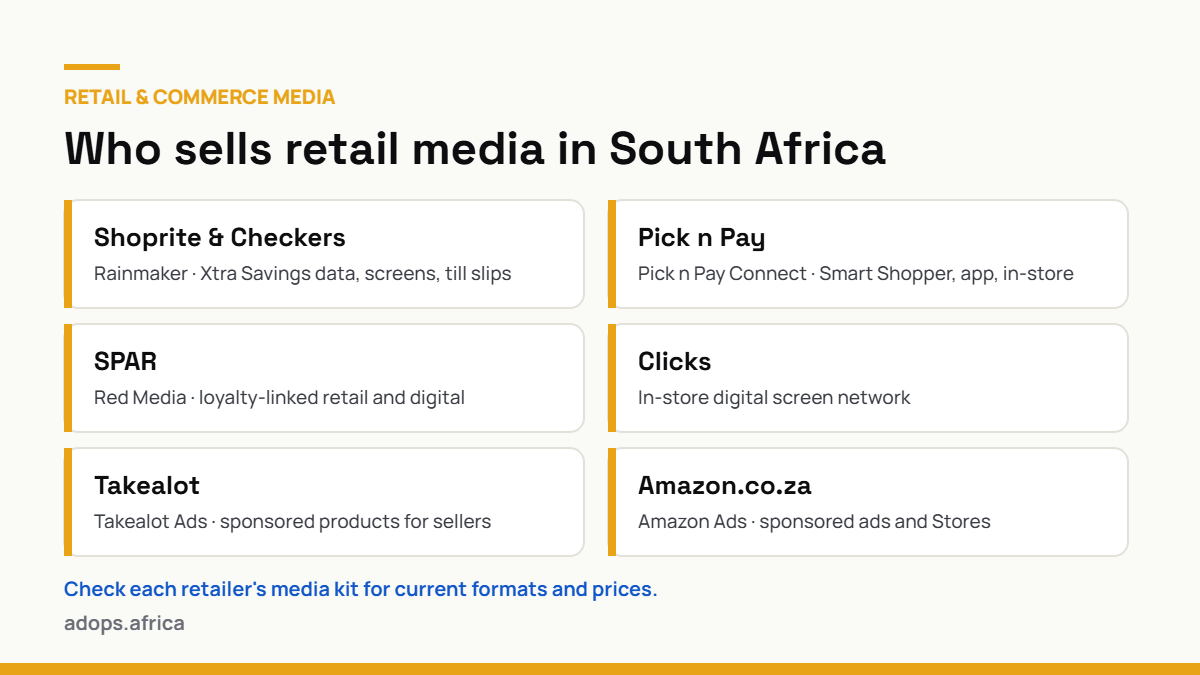
Who sells it
- Shoprite and Checkers (Rainmaker Media). The largest. Data from Xtra Savings, with in-store screens at entrances and tills, till-slip ads, shelf placement, sampling space, the app, email and USSD. The group cites 81 million monthly shoppers.
- Pick n Pay (Pick n Pay Connect). Smart Shopper data across the app, website, SMS, social and in-store screens. Pick n Pay has added display ads on its home and category pages.
- SPAR (via Red Media). Campaigns across SPAR’s retail and digital channels, linked to its loyalty programme.
- Clicks. An in-store digital screen network for supplier advertising.
- Takealot Ads. Sponsored products on search and category pages of takealot.com and the app, bought by sellers on the marketplace.
- Amazon Ads. Sponsored Products, Sponsored Brands, Sponsored Display and free brand Stores have been available on Amazon.co.za since July 2024, for eligible sellers and vendors.
Woolworths and Mr Price haven’t branded a retail media offer publicly. Ask your account managers what’s available.
Where the budget comes from
This is the question that causes the most friction. Retail media is often paid from trade budgets that used to fund discounts, shelf space and promotions, not from the media budget. Sales teams see it as a cost of doing business with the retailer; marketing teams see it as media that should meet media standards. Agree up front which budget pays, and who signs off the results.
How to buy it
- Start with your sales team. Retail media is often sold through trade marketing budgets and joint business plans. Make sure media and trade marketing talk before anyone signs.
- Pick the retailer where your sales are. Retail media works best where you already have good distribution and stock. Ads for products that are out of stock waste money.
- Choose on-site or in-store by goal. Sponsored products on Takealot or Amazon drive sales of specific products. In-store screens and till slips support launches and promotions.
- Agree measurement before you book. Ask what sales measure the retailer will report, over what period, and whether it compares against a control group. Without that, ‘ROAS’ is just a claim.
- Ask about the data. Retailers use loyalty data to target. Ask how it’s processed under POPIA and whether you receive any customer-level data. Usually, and rightly, you won’t.
Questions to ask every retailer
- What audiences can I target, and how big is each one?
- Which placements are online, in-app and in-store, and what does each cost?
- How do you measure sales, and do you use a control group?
- How quickly do I get results, and at what level of detail?
- Can I see results for products I didn’t advertise, to check for knock-on effects?
- How is shopper data protected, and who can see it?
Write the answers down. After two or three retailers, you’ll have a simple comparison that most brands don’t have.
Common mistakes
- Paying for sales that would have happened anyway. Loyal shoppers who buy your brand every week will be in any targeted audience. Ask for incremental results, not total sales.
- Treating it as separate from media. Retail media budgets often sit outside the media plan, so nobody sees total spend or frequency. Bring it into one view.
- Comparing retailers on their own reports. Each retailer measures differently. Use your own sales data where you can.
What to do this month
List the retailers that make up most of your sales and ask each one for its media kit, prices and measurement method. Then run one small test on one product, with a clear sales goal agreed in writing.
Read next: Meta’s new AI ad tools: what African advertisers can use now · WhatsApp Business for marketers: a practical guide
Sources
- The Citizen: How Shoprite built a R1bn-plus media business in plain sight (15 July 2026)
- AdVantage: Retail media in South Africa (7 September 2026)
- Osmos: Pick n Pay launches display ads
- Takealot Ads Help: Introduction to Takealot Ads
- Amazon Ads: Sponsored ads and Stores launch in South Africa
Researched and drafted with AI assistance, then reviewed, fact-checked and edited by Pilira Mwambala. See our Editorial & AI Policy.



