



In brief
- Changing a campaign every day based on noise does more harm than good.
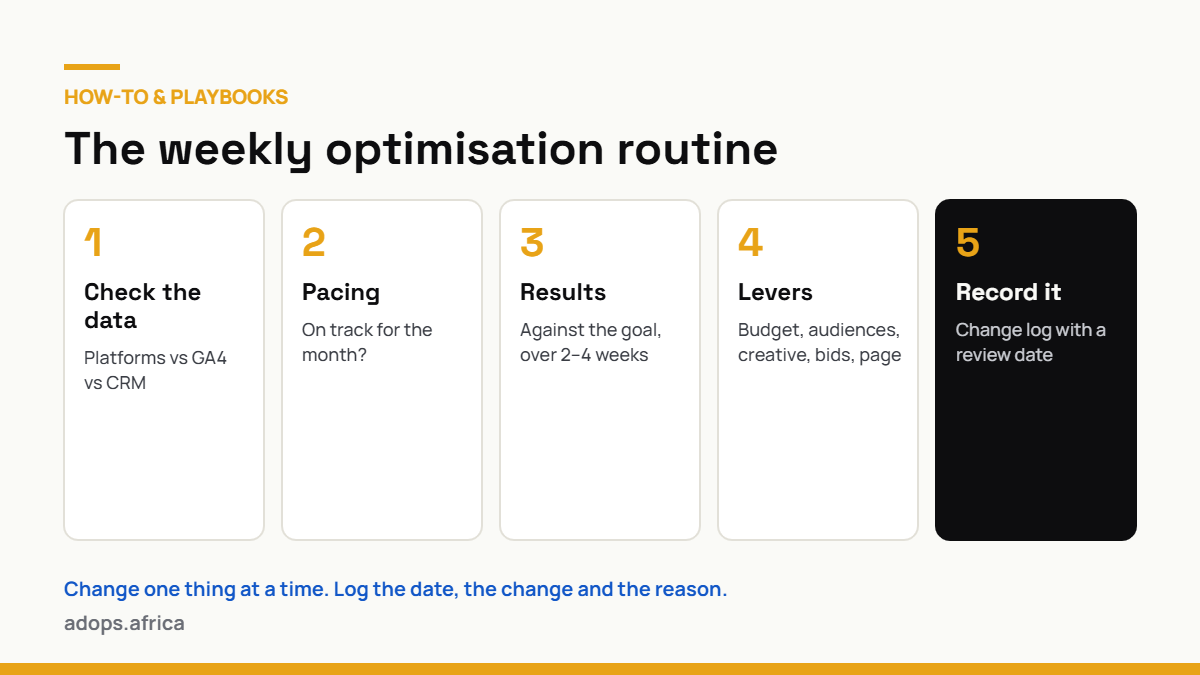
- Check the same things every week, in the same order: tracking, pacing, results, then levers.
- Change one thing at a time, write down why, and judge it after enough data.
Optimisation sounds like constant tweaking. In practice, the best campaign managers change less than you’d expect, and they change it for a reason. A weekly routine stops you reacting to noise and makes every change traceable. Here’s ours.
Before you look at results: is the data right?
- Compare conversions in each ad platform with GA4 and your CRM or sales system. A sudden drop is often a broken tag, not a bad campaign.
- Check that consent rates and tracked users haven’t changed sharply.
- Look for spikes in clicks without matching sessions: that can mean bot traffic or a broken landing page.
Pacing
- Is spend on track for the month? Under-delivery wastes reach; over-delivery runs the budget out early.
- Are any campaigns limited by budget while others underspend?
- For automated bidding, is the bid strategy still learning? Avoid big changes during the learning period.
Results, against the goal
- Start with the business result: cost per sale, lead or sign-up, compared with the target.
- Look at the trend over two to four weeks, not just last week. A single week can be noise, especially on small budgets.
- Break results down by channel, campaign, audience and device. Find the one or two segments driving most of the result, good or bad.
- Allow for the calendar. In South Africa, spending often rises around month-end paydays and falls before them, so a mid-month dip may be normal. Compare with the same point last month before you react.
Then the levers
Only now decide what to change. Typical levers, in rough order of impact:
- Budget: move money from weak to strong campaigns.
- Audience and keywords: add negatives, exclude poor placements, review the search terms report.
- Creative: refresh ads showing fatigue; test a new message.
- Bids and targets: adjust target CPA or ROAS gradually, by 10–20% at a time.
- Landing page: if clicks are cheap but conversions are rare, the problem may be the page, not the ads.
Record every change
Keep a simple change log: date, what changed, why, and when you’ll judge it. Next week, start by checking last week’s changes. This one habit turns optimisation from guesswork into learning, and it’s the first thing a new team member or client should read. A shared spreadsheet is enough: one row per change, with columns for date, campaign, change, reason, expected effect and review date.
A 30-minute weekly agenda
- Last week’s changes (5 minutes). What did we change, and what happened?
- Data check (5 minutes). Do platform, GA4 and CRM numbers still agree?
- Pacing (5 minutes). On track for the month? Any budget moves needed?
- Results (10 minutes). Against the goal, over two to four weeks, by segment.
- Decisions (5 minutes). No more than two or three changes, each logged with a reason and a review date.
Keep the meeting short and the same every week. Invite whoever can approve changes, so decisions don’t wait for a separate sign-off.
What not to do
- Don’t change everything at once. If you change bids, audiences and creative in the same week, you’ll never know which one worked.
- Don’t judge on a weekend or a public holiday. Compare like with like: a Monday with a Monday, a month-end with a month-end.
- Don’t chase cheap clicks. The lowest cost per click often brings the least valuable visitors.
- Don’t reset learning without reason. Large budget or target changes restart learning on automated bidding.
- Don’t trust one platform’s numbers alone. Each ad platform counts its own conversions generously. Check the trend against GA4 and your sales data before moving budget.
Why it matters in Africa
Smaller budgets mean less data, so results swing more from week to week. That makes it tempting to react, and dangerous. With low volumes, wait for enough conversions before judging a change, or test on a larger share of the budget so the answer comes faster. As a rough guide, wait for at least 30 conversions on each side of a comparison before calling a winner, and longer if your sales cycle runs over weeks. Our Performance Max vs Search guide covers the same problem for automated campaigns.
How to measure success
Two signs the routine is working: fewer changes reversed within two weeks, and steady improvement in the business result over a quarter. If neither happens, look at the goal and tracking before you blame the optimisation.
Share with your team
Every week: check the data, then pacing, then results, then levers. Change one thing at a time and log why.
Read next: The digital campaign launch checklist · GA4 data retention
Sources
- Google Ads Help: About bid strategy statuses (learning period)
- Meta Business Help: About the learning phase
Researched and drafted with AI assistance, then reviewed, tested and edited by Pilira Mwambala. See our Editorial & AI Policy.



