



In brief
- A launch checklist catches the cheap mistakes before they become expensive ones.
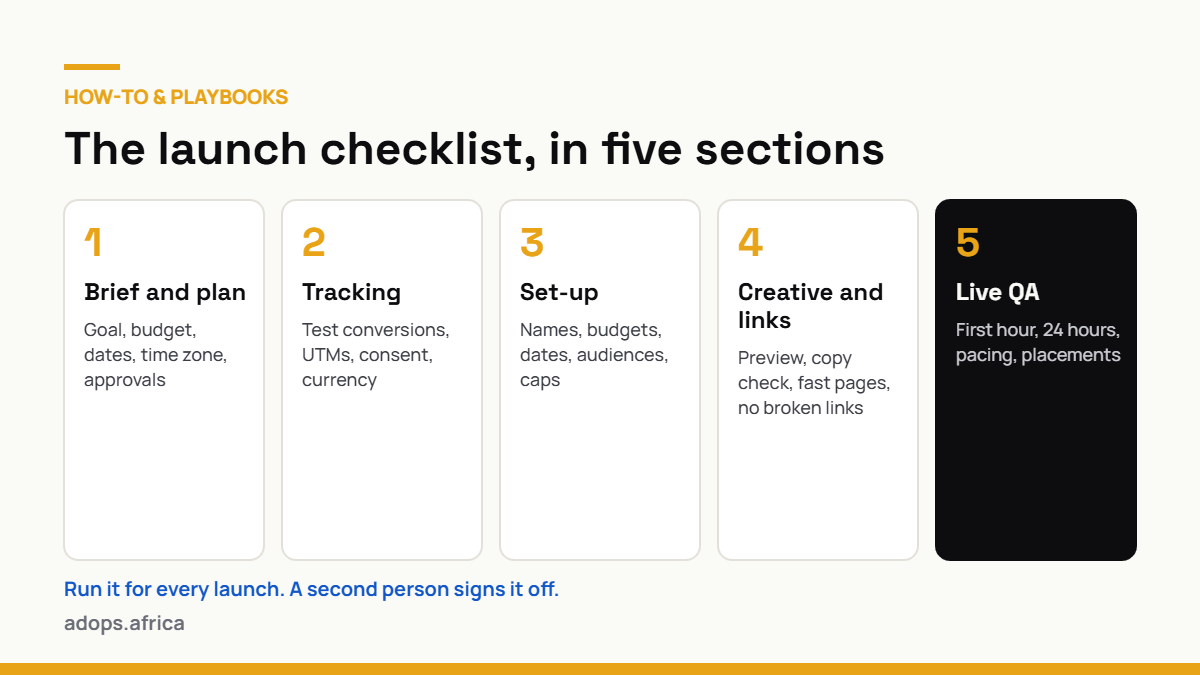
- Check five areas: brief, tracking, set-up, creative and links, then live QA.
- Run it for every launch, and make a second person sign it off.
Most campaign errors are not strategic. They’re a wrong end date, a missing UTM, a pixel that never fired, a budget with an extra zero. Each one is easy to catch before launch and painful to fix after. Here is the checklist we use, from brief to the first 48 hours live. Copy it into your own template.
1. Brief and plan
- One business goal with a target number, agreed in writing.
- Budget, flight dates and time zone confirmed. Platforms default to different time zones; South African campaigns should run on South African time.
- Audiences, markets and languages listed, with any exclusions.
- Approvals in place: client sign-off, and in Nigeria, ad approval before publishing.
- A named owner for each platform and a named person who approves changes during the flight.
2. Tracking
- A tracking plan lists every conversion, its name in each platform, and where it fires. See our tracking plan guide.
- Test conversions completed and visible in GA4 and each ad platform.
- UTM parameters follow the agreed naming convention on every link.
- Consent banner and Consent Mode working: test with consent accepted and declined.
- Conversion values and currency set correctly (ZAR, NGN, KES and so on).
3. Platform set-up
- Campaign names follow the naming convention.
- Budgets, bid strategies and daily caps match the plan. Check the decimal point.
- Start and end dates and times are right.
- Locations, languages and audiences match the brief; exclusions applied.
- Frequency caps set where the platform allows them.
- Brand safety settings and placement exclusions applied.
4. Creative and links
- Every ad previewed on mobile and desktop.
- Spelling, prices, dates and legal copy checked against the approved version.
- Every landing page loads quickly on mobile data and matches the ad’s promise.
- No broken links; redirects keep the UTM parameters.
- Ad sizes and video lengths match each placement’s specifications.
5. Live QA: the first 48 hours
- Within the first hour, confirm impressions and clicks are flowing on every platform.
- Within 24 hours, check that conversions are recorded and match what your site or CRM shows.
- Check pacing: spend should be roughly on track for the daily budget.
- Review placements and search terms for anything off-brand.
- Screenshot the live ads for the client record.
Why it matters in Africa
Budgets are smaller and flights are often short, so a week lost to a tracking error is a bigger share of the campaign. Multi-market launches add currency, language and approval risks that a single-market checklist misses. Add a line for each market you launch in. And because many African teams are small, the same person often plans, builds and reports. That’s exactly when a written checklist matters most: it replaces the second team member you don’t have.
Extra lines for multi-market launches
- Currency and conversion values set per market.
- Creative translated and checked by a native speaker, not just a translation tool.
- Local approvals and sector rules confirmed for each country.
- Payment options on landing pages match each market: cards, mobile money, EFT.
- Time zones: Lagos and Nairobi are one hour behind and one hour ahead of Johannesburg.
Why launches slip
When launches run late, it’s rarely the media. The usual causes are creative approved late, tracking not ready, landing pages still in development, and nobody with authority to sign off. The checklist helps here too: start it the day the brief is approved, not the day before launch, and the gaps show up while there’s still time to fix them.
A useful rule: if any line in sections 1 or 2 isn’t ticked three working days before launch, flag it to the client or manager. A short delay agreed in advance is better than a week of untracked spend.
Make it stick
- Keep the checklist in a shared document, with one copy per campaign.
- Have a second person sign it off. The person who built the campaign is the one least likely to spot its errors.
- Add a line every time a mistake gets through. The checklist should get better with every launch.
- Keep the signed checklist with the campaign records. When a client questions a result months later, it shows exactly what was set up, checked and approved.
How to measure success
Track launch errors found after go-live, per campaign. The number should fall over time. Also track days from final approval to launch: a good checklist speeds launches up, because fewer things go back for fixes.
Share with your team
Every launch gets the checklist and a second pair of eyes. Five sections: brief, tracking, set-up, creative and links, live QA.
Read next: The weekly optimisation routine · From brief to business outcome
Sources
- Google Analytics Help: Collect campaign data with custom URLs
- Google Tag Manager Help: Get started with Tag Manager
- TikTok Ads Help: Market-specific requirements for ad approval (Nigeria)
Researched and drafted with AI assistance, then reviewed, tested and edited by Pilira Mwambala. See our Editorial & AI Policy.



