



In brief
- Impressions, views and engagement look great on a deck, but they don’t prove a campaign moved the business.
- Facebook’s 2016 video metric error shows how a flattering number can misdirect real budgets.
- Lead every report with business outcomes, and treat delivery metrics as diagnostics.
The digital advertising industry loves a big number. Ten million impressions. One million video views. A 75% completion rate. A viral engagement spike. These numbers look fantastic in a post-campaign analysis and a client presentation. They fill a dashboard, justify spend and create the perception of success.
But as engine room practitioners responsible for media performance, we need to ask a harder question: did any of my campaign insights and recommendations actually move the business forward?
A cautionary tale
One of the best-known warnings came from Facebook. In 2016, it disclosed that it had miscalculated “average duration of video viewed” for about two years. The metric left out views of under three seconds, which made average watch times look longer. Publicis Media told The Wall Street Journal the error inflated the figure by roughly 60 to 80 percent. Facebook said billing was not affected.
Advertisers later sued, alleging much greater inflation and arguing the figures pushed more money into Facebook video. In 2019, Facebook agreed to pay US$40 million to settle the case without admitting wrongdoing. The lesson was harsh: brands, agencies and publishers had been making decisions on a metric that suggested strong engagement when the reality was far less certain.
Why should you care?
Because vanity metrics don’t just mislead a client session. They misdirect budgets.
Imagine moving millions into video because watch-time suggests audiences are highly engaged. If that metric doesn’t reflect real attention, your optimisation, channel mix and investment priorities are all compromised. The real damage isn’t the metric itself; it’s the opportunity cost. Stakeholders celebrate performance in the meeting while, in the real world, it never translates into revenue, leads, footfall, app installs or market share. That lands on the CMO and CFO, and on the reputation of everyone who signed off the report.
For agencies, vanity metrics create a credibility problem. For brands, they create a growth problem: a green dashboard hiding red business outcomes.
What does it mean in African markets?
It matters even more here. In my experience, most global brands run their African operations on tighter budgets than in Europe or North America, so every rand, naira or shilling carries more pressure to prove its value. Yet many campaign reports still lead with impressions, clicks, engagement rates and views. Those tell us whether an ad was served or interacted with, not whether a business objective was achieved.
As programmatic, retail media, social commerce and connected TV mature across Africa, we should avoid importing bad measurement habits from larger markets. More data does not automatically mean better measurement. Whether you’re buying media in Cape Town, Johannesburg, Nairobi or Lagos, business outcomes matter more than platform outcomes.
What should you do next?
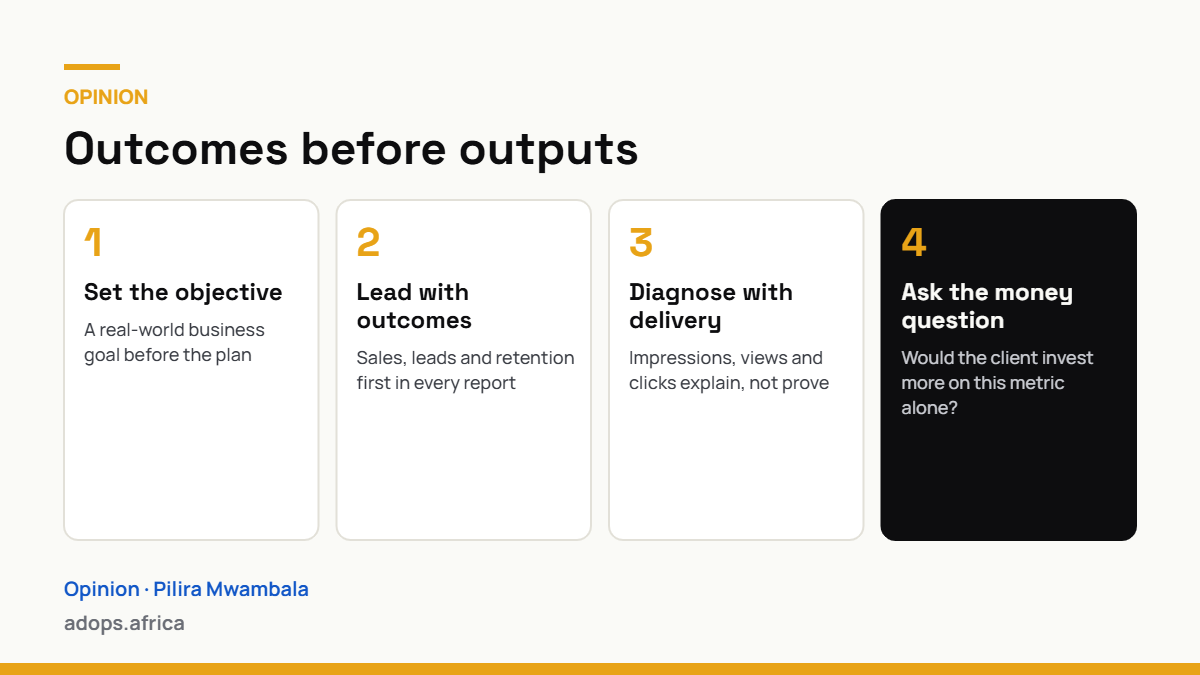
- Start every campaign with a clearly defined, real-world business objective, built into a measurement framework.
- Report outcome metrics before delivery metrics.
- Work with your client to link media to sales, leads, acquisitions or retention.
- Treat impressions, views and clicks as diagnostic indicators, not success measures.
- Use independent measurement and verification where possible.
- Challenge any platform KPI that can’t inform a business decision. Ask your Google, Meta, TikTok or LinkedIn contacts where the logic doesn’t add up, and use well-built AI prompts to interrogate the numbers when significant budget is at stake.
- Ask: “Would my client increase investment based on this metric alone?” If the answer is no, it probably isn’t the most important metric.
How do you measure success?
You know it’s working when stakeholder conversations shift from platform performance to business performance. When teams discuss cost per acquisition, incremental sales, return on ad spend, customer lifetime value and brand lift before clicks and views, measurement maturity improves. Better metrics create better decisions.
What should you share with your team?
- Not everything that can be measured matters.
- High engagement does not guarantee business impact.
- The purpose of reporting is decision-making, not dashboard decoration.
Share with your team
The best media teams don’t report the biggest numbers. They report the numbers that help businesses grow in the real world. Before every brief, there’s a real business that wants to succeed.
Read next: Can you trust your campaign numbers? · Build a measurement framework
Sources
- TechCrunch: Facebook miscalculation significantly inflated average video view times for years (22 September 2016)
- CNBC: Facebook apologizes for overstating key ad metric (23 September 2016)
- Nieman Lab: Facebook will pay $40 million to settle a lawsuit claiming it misled advertisers (8 October 2019)
- Variety: Facebook to pay $40 million to settle claims it inflated video viewing (2019)
Written by Pilira Mwambala. Edited with AI assistance for structure, fact-checking and sources. See our Editorial & AI Policy.



