



In brief
- Most campaign reports measure what’s easy to count, not what the business cares about.
- Build a chain from reach to engagement, leads, sales and profit, with one metric per step.
- Every metric should link to the one above it; if you can’t explain the link, stop reporting it.
Ask five people what a campaign achieved and you’ll get five answers: impressions, clicks, leads, sales, ‘brand awareness’. A measurement framework gets everyone to agree, before the campaign starts, on what success means at each stage, and how each number connects to the business.
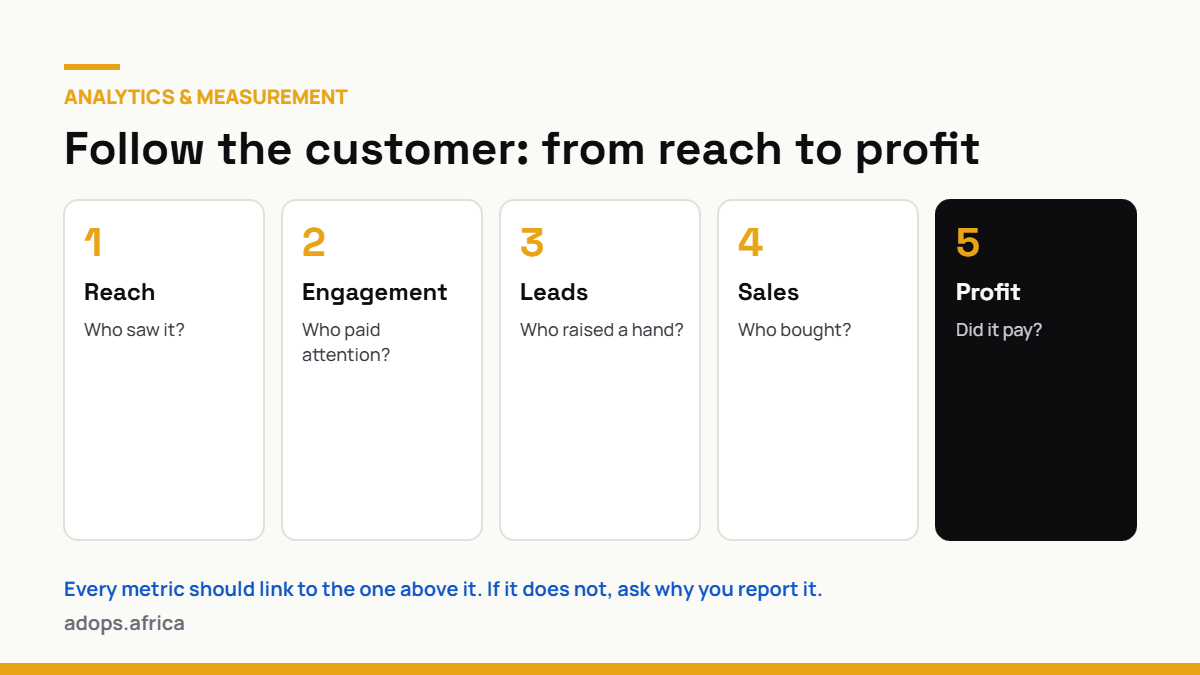
The chain
| Stage | Question | Example metrics |
|---|---|---|
| Reach | Did the right people see it? | Reach in target audience, frequency, viewable impressions |
| Engagement | Did they pay attention? | Watch time, landing page visits, engaged sessions |
| Leads | Did they raise a hand? | Qualified leads, sign-ups, add to carts |
| Sales | Did they buy? | Orders, revenue, new customers |
| Profit | Did it pay? | Gross profit, return on ad spend, customer lifetime value |
The point isn’t to report everything. It’s to pick one or two metrics per stage that link to the next one, so that a change at the top can be traced to a change at the bottom.
How to build one
- Start at the bottom. What does the business need: revenue, profit, new customers, applications? Write the target.
- Work backwards. If you need 100 sales and one in ten qualified leads buys, you need 1,000 qualified leads. If one in twenty landing-page visits becomes a lead, you need 20,000 visits. Now you know what each stage must deliver.
- Assign each channel a role. Video and display usually work at the top; search and retargeting further down. Judge each on its stage, not all on last-click sales.
- Name the source for every metric: ad platform, GA4 or CRM. Our tracking plan guide helps keep the definitions consistent.
- Agree it in writing with the client or manager before launch.
A hypothetical example
A Durban car dealership wants 40 extra sales a quarter. Its data shows one in eight test drives becomes a sale, and one in five qualified leads books a test drive. So it needs 320 test drives and 1,600 qualified leads. With a landing-page conversion rate of 4%, that means 40,000 visits from the right people.
Now the media plan has targets at every stage. If visits are on track but leads fall short, the problem is the landing page or the offer, not the media. If leads are fine but test drives aren’t, it’s the follow-up. The framework shows where to look, instead of blaming the last channel in the chain.
What about brand?
Not every campaign aims for a sale this quarter. For brand campaigns, replace the lower stages with measures of memory and preference: brand lift studies, branded search volume or survey results. The principle is the same: one chain, agreed in advance, with each step linked to the next.
Why it matters in Africa
Many African campaigns end with a lead form or a WhatsApp chat, and the sale happens later, offline. Frameworks that stop at clicks make those campaigns look either brilliant or useless, depending on the day. Connecting leads to sales, even with a monthly CRM export, is what turns media reports into business conversations.
Common mistakes
- Too many metrics. A 40-row report hides the three numbers that matter.
- Every channel judged on sales. Awareness channels look useless, get cut, and lower-funnel results fall weeks later.
- No baseline. Without last year’s or last quarter’s numbers, nobody knows if a result is good.
How to measure success
A good framework fits on one page and every metric on it has an owner and a source. Review it quarterly: if a metric never changes a decision, remove it. Our guide to connecting media performance to business value makes the case in more detail.
Share with your team
Agree one chain before launch: reach → engagement → leads → sales → profit. One or two metrics per stage, each linked to the next, each with a source.
Read next: Attribution vs incrementality · Can you trust your campaign numbers?
Sources
Researched and drafted with AI assistance, then reviewed and edited by Pilira Mwambala. See our Editorial & AI Policy.



