



In brief
- Google, Meta, TikTok and LinkedIn now want a brief, assets, signals and budget, and AI makes the campaign decisions.
- In African markets, the algorithm is global but the inputs are not. Weak data gets amplified.
- The platform optimises; you stay accountable. Trust the AI, but verify it.
For years, we were taught that campaign success came from tighter targeting, manual bid adjustments, audience segmentation and careful, campaign-by-campaign optimisation. Today, Google, Meta, TikTok and LinkedIn are asking us to do the opposite: provide business objectives, creative assets, conversion signals and a budget, then let AI make the decisions and execute everything.
Welcome to the black box of AI advertising. It’s a bittersweet topic that brings both joy and fear to digital marketers. If AI does this perfectly, is it doomsday for the engine room, a war of man versus machine?
What is the black box?
The “black box” refers to AI-driven campaign systems that automate decisions once visible to, and controlled by, human marketers. This used to be a craft where you made your mark through hours of crunching spreadsheets, and zero margin of error was a stripe you earned in the engine room.
Today, Meta Advantage+, Google Performance Max and AI Max, TikTok Smart+ and LinkedIn Accelerate use machine learning to automate targeting, bidding, placements, budget allocation and creative. They weigh real-time signals at a speed and scale no team can match to decide who sees an ad, where, and at what price. So where’s the artistry, the science and the media maths that once defined an industry of growth hackers and digital wizards?
Globally, the concept is the same. In Africa, the complexity lies not in the AI but in the market conditions feeding it. AI thrives on abundant, high-quality signals, yet many African advertisers work with fragmented tracking, inconsistent first-party data, cash-based economies and lower conversion volumes. The algorithm is global. The inputs are not.
Why should you care?
The black box already manages a growing share of your media budget, and the upside is real. AI can process more variables than any trader or optimisation team could assess manually.
So embrace the shift. Less time moving budgets between ad sets means more time on the human side of marketing: strategy, measurement, data quality and creative effectiveness. Humans buy products and services. As the human in the loop, your market context and experience are what define the brief. And when performance can’t be explained, the platform doesn’t answer to the client. You do.
What does it mean in African markets?
Import automation playbooks from Europe and North America, but adjust them locally. In South Africa, Nigeria, Kenya and Egypt, signal volumes may be large enough to support aggressive automation. Smaller markets often struggle to generate enough conversion data for algorithms to learn efficiently. Across countries, language diversity, regional buying behaviour, currencies and uneven e-commerce adoption all shape AI performance.
The biggest risk is blind trust. As reporting visibility drops, you can lose sight of what is actually driving performance. A weak conversion set-up, poor product feed or inaccurate tracking event will be amplified by automation, not corrected by it.
What should you do next?
Use a “trust but verify” approach:
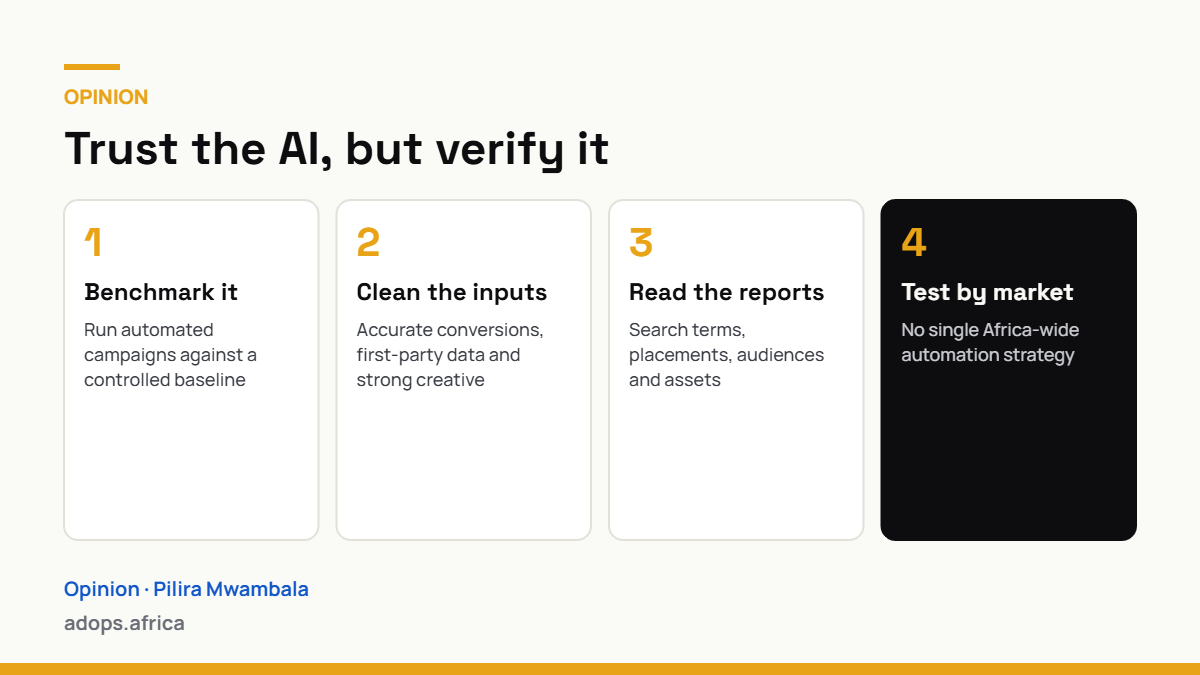
- Set clear business KPIs before you switch on automated optimisation.
- Run AI-driven campaigns alongside a controlled benchmark.
- Prioritise clean conversion tracking, first-party data and strong creative in several variations.
- Check search terms, placements, audience insights and asset reports wherever the platform shows them.
- Test market by market, not with one Africa-wide automation strategy.
How do you measure success?
Focus on local business outcomes, not platform hype. Track CPA, ROAS, customer acquisition cost, lead quality and creative fatigue. Most importantly, compare automated performance against a meaningful baseline. Better automation should create incremental value, not simply redistribute conversions you would have got anyway.
What should you share with your team?
- AI has become the operator and a great co-pilot. You’re now the strategist.
- Better inputs produce better automation. The more quality data you give the AI, the better your results.
- The competitive advantage is no longer campaign set-up. It’s data quality, measurement discipline and creative effectiveness.
Share with your team
Fear not: the black box is not replacing digital marketers. It’s changing where expertise creates value. Let the AI do what it does best, and keep the strategy, the context and the accountability with you.
Read next: AI campaign optimisation · Attribution vs incrementality
Sources
- Google Ads Help: About Performance Max campaigns
- Google Ads Help: Optimize Google Ads with AI Max for Search campaigns
- Meta for Developers: Advantage+ campaign experience for sales and app (June 2025)
- TikTok Ads Help: About Smart+ Campaigns
- LinkedIn: Accelerate Getting Started Guide
Written by Pilira Mwambala. Edited with AI assistance for structure, fact-checking and sources. See our Editorial & AI Policy.



