



In brief
- Most campaigns don’t fail at launch; they lose momentum at the hand-offs in between.
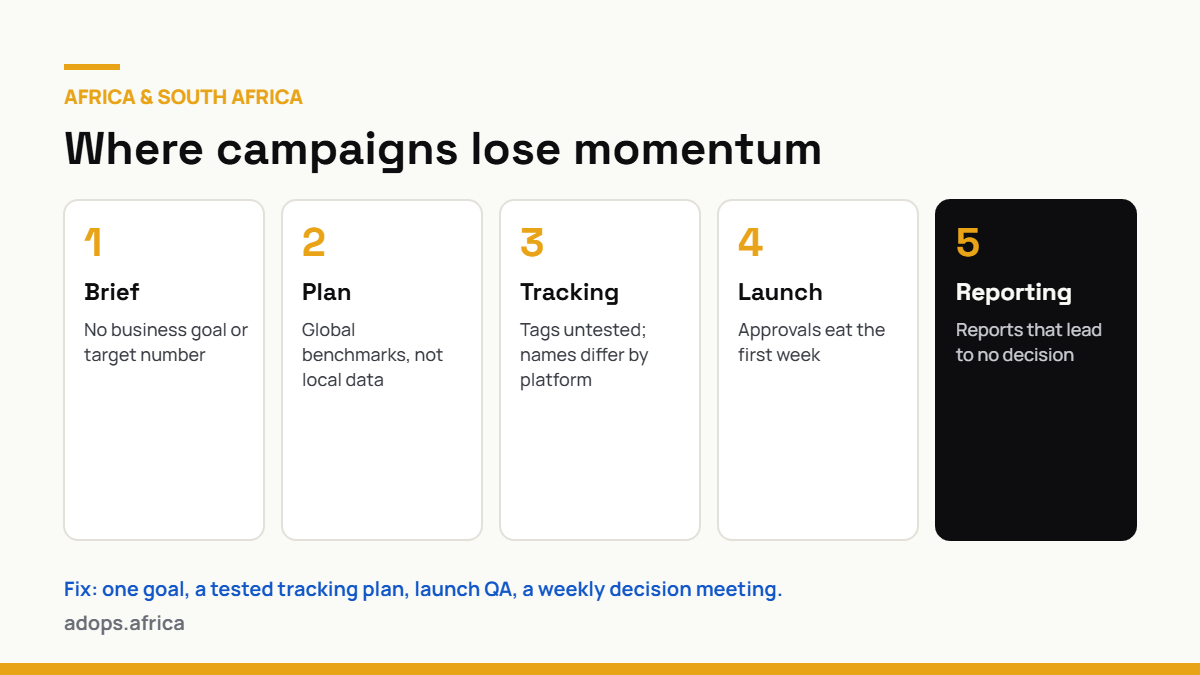
- The weak points: vague briefs, untested tracking, slow approvals and reports nobody acts on.
- Fix them with one business goal, a tracking plan, launch QA and a weekly decision meeting.
When a campaign underdelivers, the post-mortem usually blames the media: wrong channel, wrong audience, wrong bid. Often the real problem happened earlier or later, at a hand-off between teams. Here’s where African digital campaigns most often lose momentum, and how to stop it.
1. The brief
A brief that asks for ‘awareness and leads’ with no numbers gives the media team nothing to aim at. Every brief needs one business goal, a target number, a budget, dates, and who signs off. If any of those is missing, ask before planning. A good test: could someone outside the team read the brief and say, three months later, whether the campaign worked?
2. The plan
Plans built from global benchmarks often miss local realities: fewer people online, prepaid data, different platforms by country. Check that the plan’s channel roles match the goal: reach channels for awareness, intent channels for leads. Use local data, such as our Digital 2026 figures, and say which numbers are assumptions.
3. Tracking
This is where most momentum is lost. Tags go live untested, conversion names differ between platforms, consent settings block measurement nobody noticed. A short tracking plan and a test conversion before launch prevent weeks of arguing about whose numbers are right. Write down every conversion, its name in each platform, where it fires and who owns it. When a client asks why GA4 and Meta disagree, you’ll have the answer in one place.
4. Launch and approvals
Creative approvals, platform reviews and, in Nigeria, ad approval can eat the first week of a four-week flight. Build the time in, and agree who can approve changes during the flight so optimisation doesn’t wait a week for a sign-off. A launch checklist catches the avoidable errors: wrong dates, broken links, missing UTMs.
5. Optimisation and reporting
Reports that describe what happened but don’t lead to a decision waste everyone’s time. Agree a weekly rhythm: look at the numbers, decide what to change, record why. A short change log stops the same debate happening every week, and shows clients that changes are deliberate. Our weekly optimisation routine sets out the checks.
Why it matters in Africa
Smaller budgets leave less room for wasted weeks. When a four-week campaign loses its first week to approvals and its second to a tracking fix, half the learning time is gone before any optimisation starts. Teams that fix the hand-offs get more out of the same budget, which matters more where media is priced in dollars and budgets are set in rand, naira or shillings.
What to do
- Add a one-line business goal and target to every brief.
- Write a tracking plan before the media plan is final.
- Run a test conversion and a launch QA before spend starts.
- Hold a 30-minute weekly decision meeting, not just a report.
- End every campaign with a short post-mortem that changes the next brief.
How to measure success
Track two process numbers alongside results: days from brief sign-off to launch, and the share of conversions you can verify in your own systems. If both improve, results usually follow.
Share with your team
Campaigns lose momentum at the hand-offs. One goal, a tested tracking plan, launch QA and a weekly decision meeting fix most of it.
Read next: The ad ops foundations · Who owns whom in South African advertising
Sources
- DataReportal: Digital 2026 reports
- TikTok Ads Help: Market-specific requirements for ad approval (Nigeria)
Researched and drafted with AI assistance, then reviewed and edited by Pilira Mwambala. See our Editorial & AI Policy.



