



In brief
- Global platform playbooks are built on mature-market signals: fast networks, card checkouts and plenty of conversions.
- In African markets, heavy video, cheap inventory and off-site payments can starve automated bidding of good signals.
- Test before you roll out, and measure what matters locally.
As a digital marketer, this will sound familiar. It’s another day inside the engine room. You’re laser-focused on your KPI, ROI and ROAS reports when news drops from Google: a global game changer that promises to change your life. The advice is to consolidate budgets into automated campaigns, feed Performance Max (PMax) rich video assets across YouTube and Display, and let Smart Bidding do the rest.
Amazing news. But in Africa’s major digital advertising hubs (South Africa, Egypt, Kenya and Nigeria), adopting a global playbook without adjustment frequently stalls. The scenario above is a composite, not one specific announcement, but the pattern repeats every year.
Why should you care?
Smart Bidding relies on consistent signal volume and smooth conversion paths. When users on expensive data skip heavy video or abandon a landing page before it loads, conversion signals become sparse and noisy. In my experience, the algorithm then optimises for cheap clicks and low-impact placements to hit volume. CPA climbs, ROAS falls, and valuable client budget goes on impressions that never really rendered. For teams managing tight African budgets, an unadjusted global playbook destroys capital efficiency.
What does it mean in African markets?
African media consumption is overwhelmingly mobile-first, but it is constrained in three major ways:
- Connectivity and asset weight. The GSMA calls affordability the primary constraint on mobile internet in Sub-Saharan Africa, and 63% of Africans live within mobile broadband coverage but are not online. Those who are online often use data-saver modes. Heavy HD video loads slowly and completes poorly compared with lightweight static or short-form motion.
- Inventory quality. Unchecked automated expansion can push impressions into low-performing long-tail mobile apps and sites, just to fulfil delivery volume.
- Conversion friction. Global set-ups assume a frictionless web checkout. Where mobile money, USSD or cash on delivery are common, as in Kenya and Ghana, a URL-based conversion tag misses the sale unless you send it back yourself.
What should you do next?
So, do you switch on the new feature? Yes, but with caution. There’s real FOMO, but reason always prevails. This is where test and learn earns its keep: roll out the global best practice inside a localised test framework, so you don’t throw away what your campaigns have already learnt.
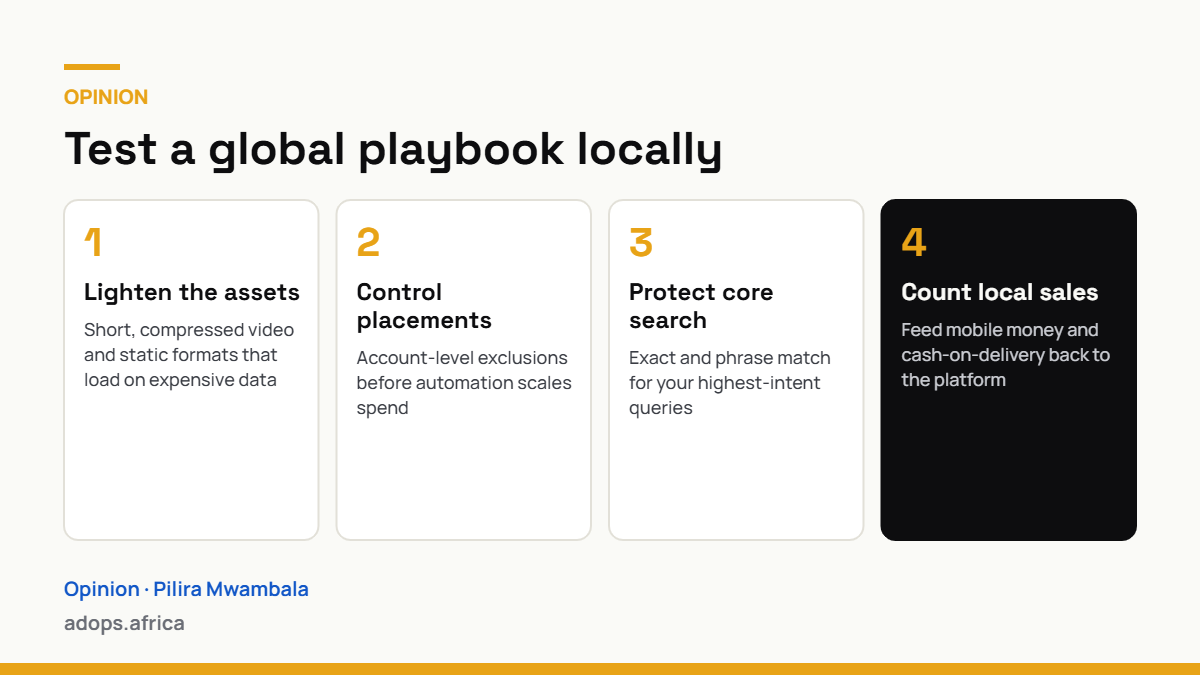
- Lighten the assets. Replace long HD video files with compressed 6 to 15-second vertical video, static images and lightweight HTML5 banners.
- Control placements. Set account-level placement exclusions before automated bidding scales spend. Google says these apply to all campaigns in the account, including PMax.
- Protect your core search. Keep exact and phrase match Search campaigns for your highest-intent queries. Google says that when a query is identical to a Search keyword, the Search campaign is preferred over PMax.
- Count local sales. Use offline conversion imports or server-side tracking to feed mobile money and cash-on-delivery conversions back into the platform.
How do you measure success?
Google is a behemoth, and there’s plenty of logic in its recommendations, but they are built mostly for mature markets. So shift your measurement from vanity metrics to localised efficiency indicators:
- Cost per completed view (CPCV) on mobile networks, to benchmark how well video holds attention.
- Landing page load rate: landing page sessions divided by clicks. A big gap points to data drop-off.
- Blended CAC and ROAS: true acquisition cost, including verified offline and mobile money conversions.
- Placement waste: the share of spend going to non-converting display and app inventory.
What should you share with your team?
Global best practice is not always African best practice. In nearly two decades of digital marketing, I’ve learnt that global best practice is great, but it should be taken with a pinch of pixels. Market context plus a test-and-learn framework solidifies the logic before you share it in-house or ask clients to build it into media plans.
Share with your team
Automated bidding is only as smart as the African market signals you feed it. Global documentation provides the engine; local parameters supply the fuel. Before turning on full automation, prioritise lightweight creative, enforce strict placement lists and make sure conversion tracking counts local payment routes.
Read next: Performance Max vs Search in low-volume African markets · Google Ads conversion tracking QA
Sources
- Google Ads Help: How Performance Max interacts with other campaigns in your account
- Google Ads Help: Exclude placements at the account level
- Google Ads Help: Set up offline conversions using Google Click ID (GCLID)
- GSMA: The Mobile Economy Africa 2026 (June 2026)
Written by Pilira Mwambala. Edited with AI assistance for structure, fact-checking and sources. See our Editorial & AI Policy.