



In brief
- Programmatic means buying ad impressions automatically, one at a time, through an auction or a pre-agreed deal.
- Five players sit between brief and bid: advertiser, DSP, exchange, SSP and publisher.
- In Africa, the questions are where the quality local inventory is, how clean the path to it is, and what each layer costs.
Programmatic advertising sounds technical, and the jargon doesn’t help. But the idea is simple: instead of booking ads by calling a publisher, software buys individual impressions automatically, based on who’s likely to see them and what they’re worth to you. Here’s how it works, from brief to bid, and what’s different in African markets.
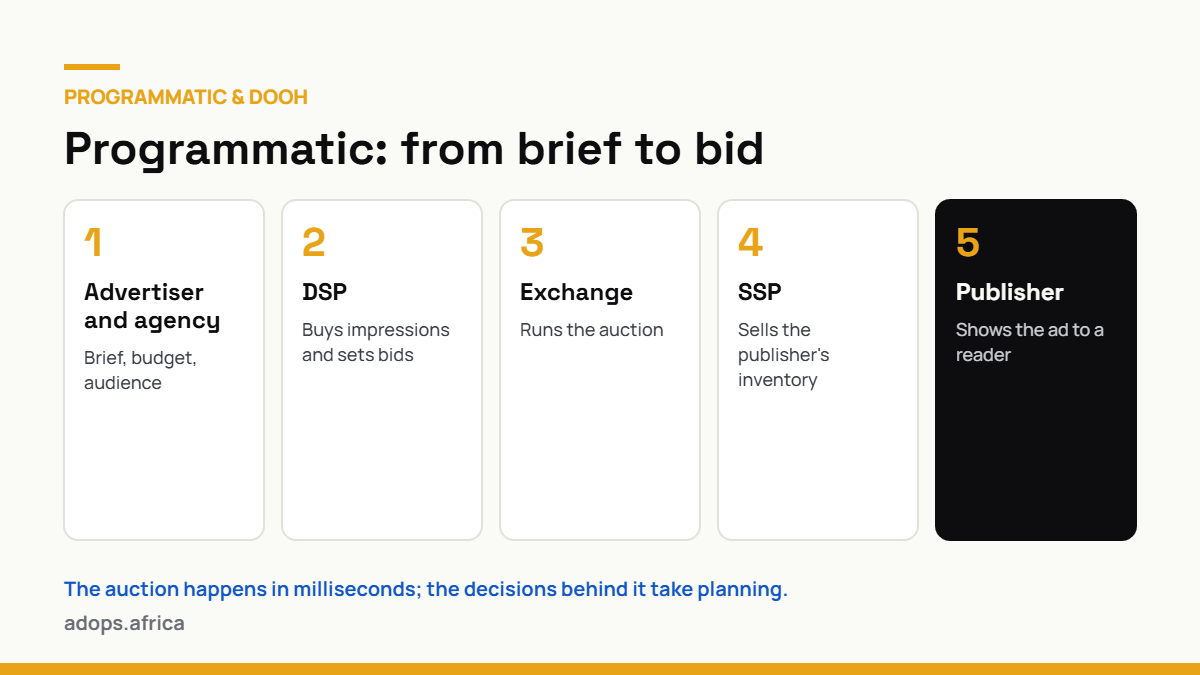
The players
- Advertiser and agency: set the goal, audience, budget and rules.
- DSP (demand-side platform): software the buyer uses to bid on impressions, such as Google’s Display & Video 360 or The Trade Desk.
- Ad exchange: the marketplace where the auction happens.
- SSP (supply-side platform): software publishers use to sell their ad space to many buyers at once.
- Publisher: the website or app where the ad appears.
What happens in a fraction of a second
- Someone opens a page or an app with ad space.
- The publisher’s SSP sends an ad request to exchanges, with information about the page, device and, where consent allows, the user.
- DSPs evaluate the impression against their campaigns and bid.
- The highest valid bid wins, and the winning ad is shown.
- The impression, and any click or conversion, is recorded for reporting.
All of that typically happens in well under a second, millions of times a day, following industry standards such as the IAB Tech Lab’s OpenRTB protocol.
Ways to buy
| Type | How it works | Good for |
|---|---|---|
| Open auction | Any buyer can bid on available inventory | Reach and scale at lower prices |
| Private marketplace (PMP) | Invited buyers bid on selected inventory | Quality publishers, brand safety |
| Preferred deal | Fixed price, first look, no guaranteed volume | Priority access without commitment |
| Programmatic guaranteed | Fixed price and volume, bought through a DSP | Big launches with set placements |
Why it matters in Africa
- Inventory quality varies. Much open-auction inventory in African markets is global apps and sites. The best local publishers, news sites and broadcasters’ streaming services are often only available through private deals.
- Mobile and apps dominate. Plan for in-app and mobile web, with formats that load fast on prepaid data.
- Every layer takes a cut. Fees for the DSP, data, verification, exchange and SSP add up. Our supply-path optimisation explainer shows how to keep more of your budget working.
- Measurement needs care. Verify viewability and fraud with a third-party tool, and check that audience data is collected with consent.
Data and audiences
Programmatic can target by context (the page or app), by audience (people who visited your site, or segments from data providers), or both. As third-party cookies and mobile identifiers become less available, context and your own first-party data matter more. In many African markets, third-party audience data is thin or of uncertain quality, so contextual targeting on the right local publishers is often the more reliable starting point.
Whatever data you use, check where it came from and that people agreed to it. Under POPIA, using personal information for advertising needs a lawful basis, and that applies to data you buy as well as data you collect.
How to start
- Decide what programmatic is for in your plan: reach, specific audiences, or specific publishers.
- Choose a DSP or a partner who runs one, and ask for a list of the local publishers and deals they can access.
- Start with private deals on quality local publishers, plus a small open-auction test.
- Use ads.txt and sellers.json checks, brand safety settings and a verification tool from day one.
How to measure success
Judge programmatic on the outcome you bought it for: reach and frequency in the right audience for awareness, cost per visit or conversion for performance. Check where your ads actually ran, by domain and app, at least monthly. The placement report is the most honest document in programmatic.
Share with your team
Programmatic is automated buying of single impressions. In Africa, focus on quality local inventory through private deals, clean supply paths, verification and checking where ads actually ran.
Read next: Supply-path optimisation, explained · DV360 campaign QA
Sources
Researched and drafted with AI assistance, then reviewed, fact-checked and edited by Pilira Mwambala. See our Editorial & AI Policy.



