



In brief
- Influencer reach and likes don’t tell you whether creator content sold anything.
- Measure audience fit, attention, action and incremental sales, and plan the measurement before the post.
- Every paid post must be clearly labelled as advertising, such as #Ad, under the ARB Code.
Influencer marketing has grown up, but its reporting often hasn’t. Many campaign reports still end with reach, views and engagement rate, and a screenshot of nice comments. Those numbers say a post was seen. They don’t say whether it worked. Here’s what to track instead.
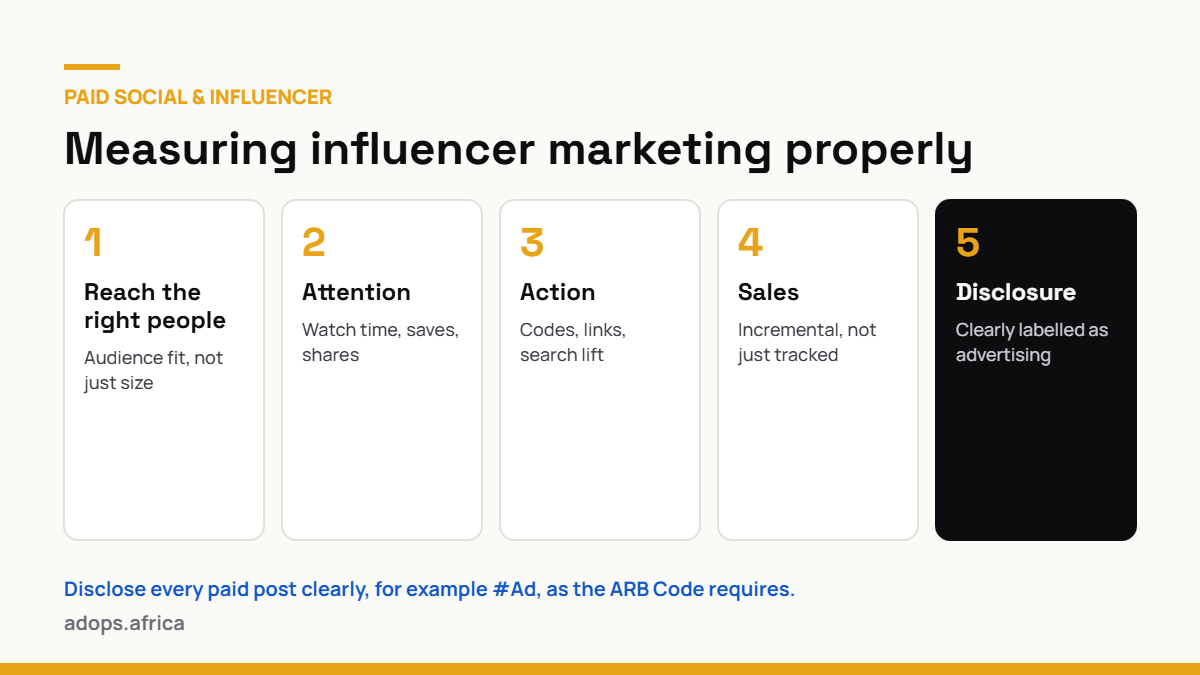
1. Audience fit, before you pay
Ask creators for audience data from their platform’s own insights: age, gender, location by country and city. A creator with a million followers, mostly outside your market, is worth less than one with 50,000 in Johannesburg and Lagos. Screenshots from the app are the minimum; screen-share or platform reports are better.
2. Attention, not just views
A ‘view’ can mean two seconds. Ask for average watch time, completion rate, saves and shares. Saves and shares show people found the content worth keeping or passing on, which is a stronger signal than a like.
3. Action
- Unique links and codes: give each creator a UTM-tagged link and a discount code, so you can see traffic and sales per creator. Follow your tracking plan naming.
- Search lift: watch branded searches in Google Search Console or Google Trends during and after the campaign.
- Paid amplification: boosting creator posts as ads, through Meta’s partnership ads or TikTok’s Spark Ads, gives you the platforms’ normal ad reporting on that content.
4. Sales, and whether they’re extra
Codes and links undercount, because many people see a post and buy later, elsewhere. Platforms’ own conversion numbers tend to overcount. The honest answer is somewhere between. For bigger campaigns, compare sales in regions or periods with and without creator activity, or run a holdout test. Our attribution vs incrementality explainer covers how.
5. Disclosure is not optional
The Advertising Regulatory Board’s Code requires advertising to be recognisable as advertising, and that includes paid influencer posts. Label them clearly and up front, for example with #Ad or #Sponsored, not hidden at the end of a long caption. Put the requirement in the creator’s contract and check every post before you pay.
Contracts that make measurement possible
- Access to post insights, by screenshot or shared report, within a set number of days after posting.
- Usage rights, so you can run the content as ads and measure it properly.
- The disclosure wording and placement, agreed in writing.
- Payment linked to delivery and insights, not just to the post going live.
Why it matters in Africa
Creators often have more trust than brands in African markets, and smaller creators can be very affordable. That makes measurement more important, not less: it’s easy to spread a budget across dozens of creators without knowing which ones moved sales. Start with a few, measure properly, and scale the ones that work. Long-term partnerships with the creators who deliver usually beat one-off posts with many, because audiences trust repeated, genuine recommendations more.
How to measure success
Before the campaign, agree one business measure (sales, sign-ups or leads), one attention measure (watch time or saves) and the disclosure rule. After it, report cost per business result by creator, and decide who to work with again.
Share with your team
Judge creators on audience fit, attention and real sales, not reach and likes. Give each a tracked link and code, and make sure every paid post is clearly labelled #Ad.
Read next: Creative fatigue or audience saturation? · Meta Ads structure for small budgets
Sources
- Polity (Adams & Adams): Compliance with advertising standards: South African influencers and the ARB (30 January 2025)
- Advertising Regulatory Board (South Africa)
Researched and drafted with AI assistance, then reviewed, fact-checked and edited by Pilira Mwambala. See our Editorial & AI Policy.



