



In brief
- Meridian is Google’s free, open-source marketing mix model: it estimates what each channel contributes to sales, without cookies or user-level data.
- The software is free; the data, skills and time are not.
- Most African advertisers should start with clean data and lift tests, then model.
Marketing mix modelling (MMM) is back in fashion. With cookies fading and platforms reporting their own results, marketers want an independent view of what each channel actually contributes. Google’s answer is Meridian, an open-source MMM that anyone can download for free. But free software is not the same as a free project. Here is what Meridian needs, what it really costs, and whether South African and wider African budgets justify it.
What is Meridian?
Meridian is a Bayesian marketing mix model built and maintained by Google and published as open-source Python code. It uses aggregated data, such as weekly spend and sales, rather than cookies or user-level tracking, to estimate how much each channel contributed to your results and what return it delivered. Because the code is public, your analysts, agency or measurement partner can see exactly how the results are calculated, rather than trusting a black box.
A few features set it apart from older MMMs:
- Geo-level modelling. It can model regions or provinces together, which gives it far more data to learn from than a single national series.
- Calibration with experiments. You can feed in results from lift tests as “priors”, so the model starts from what you already know. In September 2026, Google made GeoX, its open-source tool for geographic experiments, generally available, with results designed to feed into Meridian.
- Reach and frequency. For channels such as YouTube, it can use reach and frequency rather than impressions alone.
- Budget planning. Since February 2026, a no-code Scenario Planner lets non-technical marketers test budget splits and see estimated returns.
Google also announced at Google Marketing Live in May 2026 that Meridian is coming into Google Analytics 360, its paid enterprise analytics product.
Why should you care?
Platform dashboards answer the question “what did this platform see?”. Attribution answers “which touchpoints were on the path?”. Neither tells you what would have happened without the spend. MMM tries to, using variation in your spend over time and across regions. If you want the difference explained simply, read our guide to attribution vs incrementality.
MMM also covers channels that click-based tracking misses: TV, radio, out-of-home and print, which still carry a large share of budgets in many African markets.
What Meridian needs
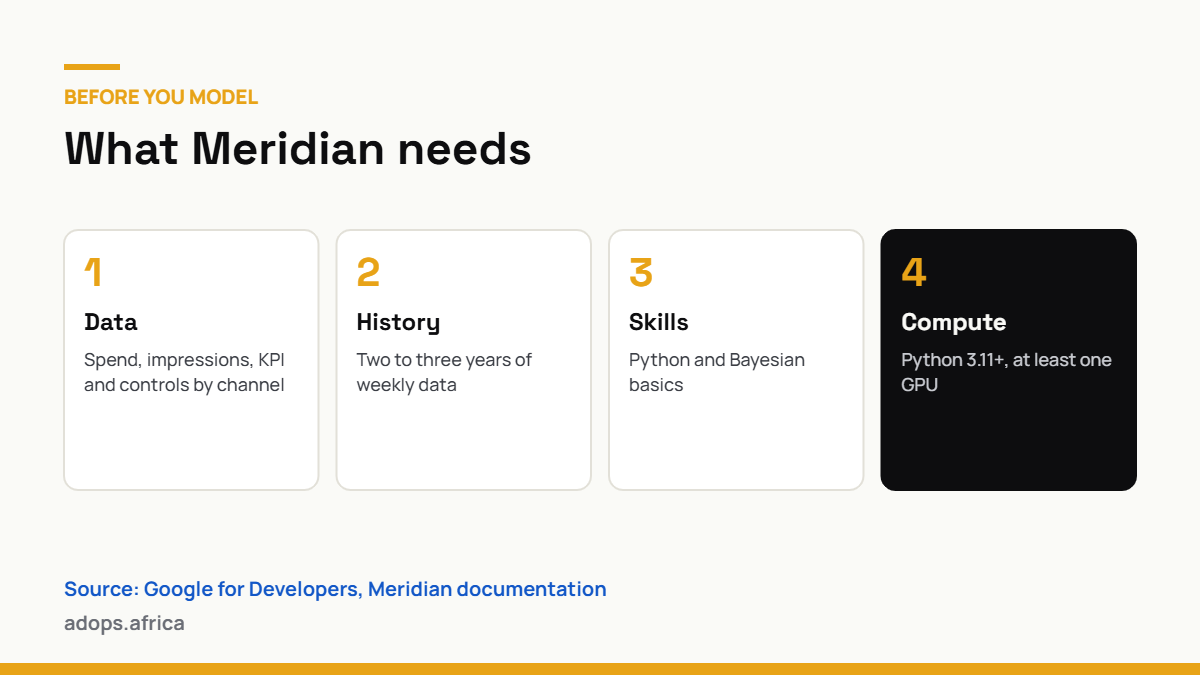
Data. At minimum: your KPI (sales, leads or another outcome) and, for each media channel, spend plus an exposure measure such as impressions. Add controls for things that also move sales, like price changes, promotions, seasonality and competitor activity. If you can, collect it by region as well as nationally.
History. Google calls its guidance “rough and directional”, but its own example is telling. A national model with 12 channels, 6 controls and 2 years of weekly data has about 4 data points per parameter, which Google calls “too low to estimate the model reliably”. Cutting to 3 channels and using 3 years of weekly data gives roughly 15 points per parameter. In practice, plan for two to three years of clean weekly data, and combine small channels.
The right level. Meridian is built for channel-level data. Google says it generally doesn’t recommend modelling individual campaigns, because campaigns that start and stop abruptly distort the results.
Skills. You need someone comfortable with Python and with the basics of Bayesian statistics: setting priors, reading credible intervals and checking whether the model fits. This is a data scientist’s job, not an add-on for a busy media planner.
Compute. Meridian requires Python 3.11 or 3.12. Google recommends at least one GPU and says it has been tested on V100 and T4 GPUs with 16 GB of RAM. A cloud notebook with a GPU is enough to start.
What does it cost?
The software is free. The real costs are elsewhere:
- Data work. Pulling two to three years of spend, impressions and sales, by channel and ideally by region, and cleaning it, is usually the biggest job. Much of that history may sit with agencies, publishers and finance teams.
- People. A data scientist or a specialist partner to build, check and update the model.
- Experiments. Geo or lift tests to calibrate the model cost media money, because you hold back or increase spend in test regions.
- Compute. Usually small, but GPU time adds up if you rerun models often.
What does it mean in African markets?
Meridian can work well for larger advertisers in South Africa, Nigeria, Kenya, Egypt and Ghana, especially those who spend across TV, radio, outdoor and digital. But three local realities matter.
First, data history. Many brands don’t have two to three years of consistent, channel-level spend and sales data, particularly where agencies changed or offline sales are recorded by distributors. Second, regional data. Geo models need reliable sales and spend by region, which is often missing for national TV, radio or informal retail. Third, budget scale. If your monthly media budget is small, or spent in one or two channels, the model has little variation to learn from, and its estimates will be wide.
Hypothetical example: a South African retailer spends on TV, radio, Meta, Google and out-of-home, has three years of weekly sales by province, and runs regular promotions. That is a good candidate. A start-up with eight months of data and two digital channels is not, and will learn more from clean reporting and simple lift tests.
What should you do next?
- Check readiness. Do you have two to three years of weekly spend, impressions and sales by channel? If not, start collecting now, in a consistent format.
- Fix measurement basics. Agree KPIs that link to business value, using a measurement framework that follows the customer journey.
- Centralise the data. A warehouse such as BigQuery makes it easier to combine platform, analytics and sales data. Our GA4 to BigQuery guide is a good start.
- Run lift tests. Even one well-designed test gives you an independent number and a prior for the model later.
- Pilot Meridian. Start with a small model: a few channels, national data, clear priors. Use Google’s getting-started notebook, and compare results with what you already know before changing budgets.
Meridian is not the only option. Meta’s Robyn is another free, open-source MMM, and specialist measurement partners offer managed models. The questions above apply to all of them.
How do you measure success?
- Credible intervals: are the return estimates narrow enough to act on? Wide ranges mean more data or simpler models are needed.
- Agreement with experiments: do model results line up with lift-test results?
- Out-of-sample fit: does the model predict a holdout period it hasn’t seen?
- Decisions: did a budget change based on the model lead to the expected result in the next quarter?
Share with your team
Before we model anything, we’ll check we have two to three years of clean weekly data by channel, run at least one lift test, and pilot Meridian with a small, simple model. We won’t move budget on the results until they agree with our experiments.
Read next: Attribution vs incrementality · Building a measurement framework that follows the customer journey
Sources
- Google for Developers: Meridian, Amount of data needed
- Google for Developers: Install Meridian
- Google Ads & Commerce Blog: New Meridian tool puts MMM insights directly in marketers’ hands (Harikesh Nair, 19 February 2026)
- TechWyse: Google takes Meridian GeoX to general availability globally (11 September 2026)
- PPC Land: Meridian lands inside Analytics 360 (20 May 2026)
- GitHub: google/meridian
Researched and drafted with AI assistance, then reviewed, fact-checked and edited by Pilira Mwambala. See our Editorial & AI Policy.



