

In brief
- When paid social results slip, the cause is usually tired creative or an audience that has seen it all.
- Read four signals together: cost per result, CTR, frequency and CPM.
- Fatigue needs new creative; saturation needs a wider audience or more budget discipline.
Your Meta or TikTok campaign was working. Now cost per result is creeping up and nobody changed anything. The usual suspects are creative fatigue (people are tired of the ad) and audience saturation (you’ve reached most of the people you can). They look similar but need different fixes. Here’s a repeatable way to tell them apart.
Step 1: Confirm it’s real
Before diagnosing anything, check that results really fell. Compare the last two weeks with the two before, not yesterday with last Tuesday. Check that tracking hasn’t changed: a broken pixel or a new consent banner can look exactly like a performance drop. And allow for the calendar: month-end paydays, school holidays and public holidays all move results in South Africa.
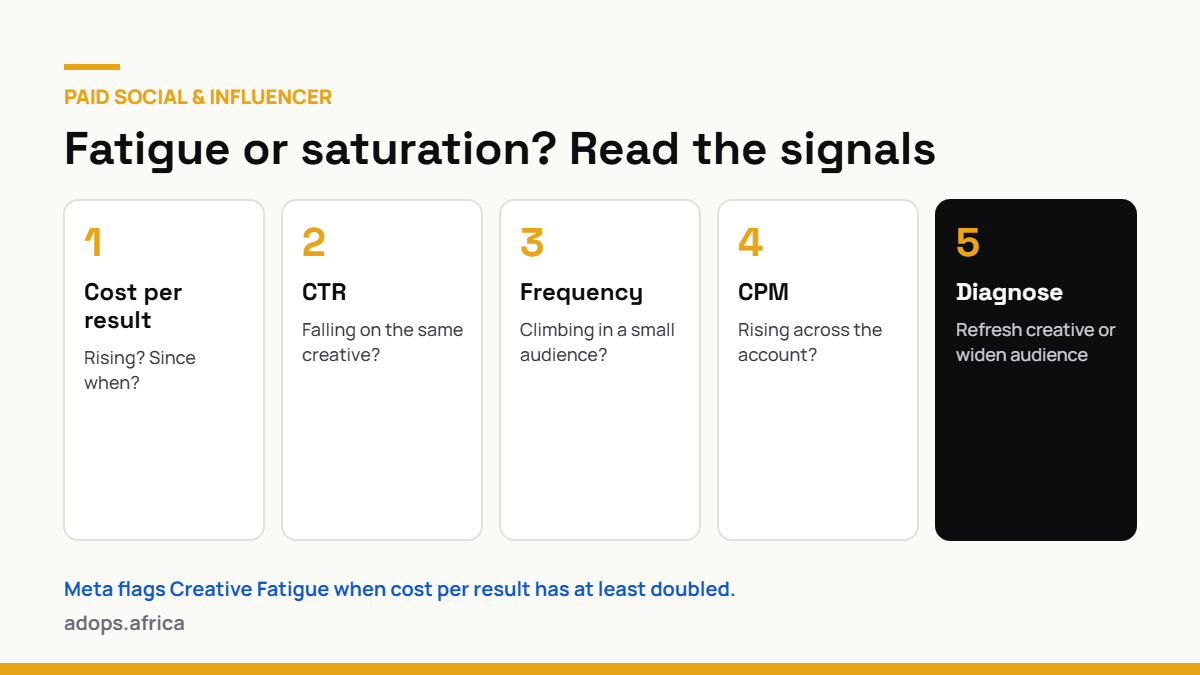
Step 2: Read four signals together
- Cost per result: the headline problem. When did it start rising?
- Click-through rate (CTR): if it’s falling on the same ads, people are responding less to the creative.
- Frequency: how often the average person has seen your ads. Rising frequency in a fixed audience means you’re showing the same people the same thing.
- CPM (cost per thousand impressions): if it’s rising across the account, competition is up, which is common in November and December, and not your creative’s fault.
Step 3: Diagnose
| What you see | Likely cause | What to do |
|---|---|---|
| CTR falling, frequency rising, same ads for weeks | Creative fatigue | New creative: new hooks, formats, people |
| Frequency high, CTR steady, results falling | Audience saturation | Widen the audience or reduce budget |
| CPM up across all campaigns | Market competition | Hold steady; judge on cost per sale |
| Sudden drop on one day | Tracking or delivery issue | Check pixel, consent and ad status |
Meta also helps here. In Ads Manager, the Delivery column can show ‘Creative Fatigue’ when an ad’s cost per result has at least doubled compared with its past performance, or ‘Creative Limited’ when costs have risen but by less. Treat these as a prompt to look, not a final verdict.
Fixing creative fatigue
- Refresh, don’t just tweak. A new colour rarely helps. Change the hook, the format (video, carousel, static), the person on screen or the offer.
- Keep a pipeline. Plan new creative every few weeks rather than waiting for results to fall.
- Test inside the ad set. Add new ads to the existing ad set so it keeps its learning; our Meta structure guide explains why.
Fixing audience saturation
- Go broader. Remove narrow interest stacks, use broad or Advantage+ audiences, or add new regions or markets.
- Lower the spend if the audience truly is small, such as a niche B2B audience. Spending more just shows the same people more ads.
- Change the goal. If prospects have all seen you, shift some budget to retargeting or to channels that reach new people.
TikTok and other platforms
The same logic applies beyond Meta. On TikTok, creative wears out faster, because people scroll quickly and expect native, trend-led content; plan refreshes more often and use creators where you can. On YouTube, watch for falling view rates on the same in-stream ads. On LinkedIn, B2B audiences are small, so saturation often comes before fatigue: frequency climbs quickly once you’ve reached most of the decision-makers in a sector.
A worked example
Take a hypothetical Lagos fashion retailer whose Meta cost per purchase has risen from ₦4,000 to ₦7,500 over three weeks. CTR on its two best ads has halved, frequency in its 25-to-34 Lagos audience has passed 6, and CPM is flat. That points to fatigue in a small audience. The fix: three new creatives in the existing ad set, plus widening the audience to Abuja and Port Harcourt. Two weeks later, cost per purchase is back near ₦4,500.
Why it matters in Africa
Smaller markets and narrow targeting saturate faster. A campaign aimed at Cape Town professionals or one Nigerian city can reach most of its audience in days. Production budgets are often small too, so teams run the same creative too long. A simple rule helps: plan at least two fresh creatives per month for any always-on campaign, even if they’re simple phone-shot videos.
Common mistakes
- Blaming the algorithm. Most drops have a cause you can see in the four signals.
- Duplicating ad sets to ‘reset’ them. It restarts learning and often makes things worse.
- Changing creative and audience at once. You won’t know which fixed it.
How to measure success
After a fix, give it at least a week and compare cost per result and CTR with the period before the drop. Keep a log of creative launch dates; over a few months you’ll learn how long your creative typically lasts, and you can plan refreshes before results fall.
Share with your team
When paid social slips: check tracking first, then read cost per result, CTR, frequency and CPM together. Tired creative needs new ideas; a saturated audience needs more people or less spend.
Read next: Meta Ads structure for small budgets · The weekly optimisation routine
Sources
- Jon Loomer: Creative fatigue: what it is and how to prevent it (15 September 2025)
- Meta Business Help: About the learning phase
Researched and drafted with AI assistance, then reviewed, tested and edited by Pilira Mwambala. See our Editorial & AI Policy.